Sunday, 11 October 2026

3DHOP x-ray tool 2.0

Hi everyone,

Last May I released the x-ray tool, a small extension for 3DHOP I had developed during the 3D documentation project of the Similaun mummy (Ötzi). It loads two aligned meshes of the same subject, an outer surface and an inner structure, and lets you make the outer one semi-transparent, so that what is inside becomes visible without moving the camera. In the first version the effect was a simple on/off toggle.

I have just published version 2.0, which turns that toggle into a real-time control. A new x-ray intensity slider, at the bottom centre of the viewer, regulates the transparency of the outer shell continuously, from an almost invisible shell to a dense "ghost"; the value used on the Ötzi project, 0.9, is still the default, and the toolbar button remains as an on/off shortcut. Version 2.0 also adds the standard 3DHOP measure tool, calibrated in millimetres.

To make the tool easier to try, the repository now includes a live demo on GitHub Pages: lucaarcteam.github.io/3dhop_x-ray_extension/x-ray.html. The demo subject is a left hand with two rings, a homage to Wilhelm Röntgen's first radiograph (Hand mit Ringen, 1895): you can orbit the model, switch the x-ray on and drag the slider to see the bones appear through the skin in real time.

Below, you can see the live demo of the x-ray tool 2.0.
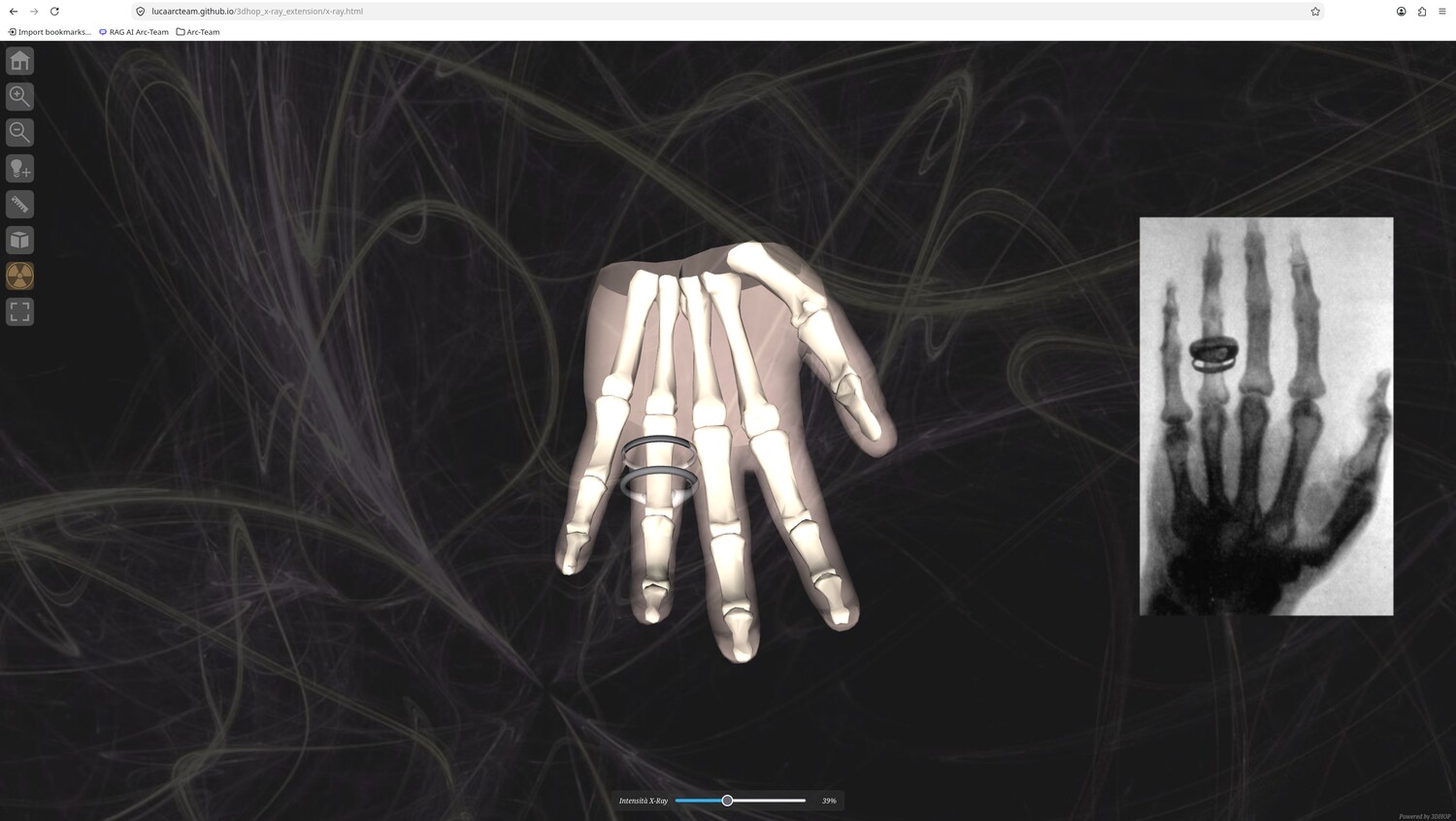
The x-ray tool 2.0 live demo: the Röntgen hand, with the x-ray slider and the skeleton visible through the skin.

Everything runs in the browser with static files, with no server-side code. As in the first version, the 3DHOP core is left untouched: all the extension logic lives in the x-ray.html page and uses the native transparency API, so the tool keeps working with upstream 3DHOP. The code is released under GPL-3.0-or-later, while the demo models come from the open Z-Anatomy atlas (CC BY-SA 4.0).

You can find the source code, the live demo and the release notes on GitHub. The tool was born within the study published in Heritage 2026.

I hope you find this useful. Have a nice day!


Saturday, 10 October 2026

DendrOS, an open-source dendrochronology software

Hi everyone,

Together with Mauro Bernabei (CNR-IBE, the Institute of BioEconomy of the Italian National Research Council), I have been developing a new piece of open-source software for our field: DendrOS.

DendrOS is a cross-platform application for dendrochronological analysis and cross-dating of tree-ring width series. It is written in Python with a PyQt6 interface and released under the GNU General Public License v3, so it runs on Linux and Windows and can be read, modified and redistributed like the rest of our Arc-Team tools.

The project started from a practical need. Many dendrochronologists still rely on PAST4 or PAST5. They are solid reference software, but closed-source and Windows-only, and they no longer fit the open workflow we built around our other projects. DendrOS aims to bring the same working method into the open-source world.

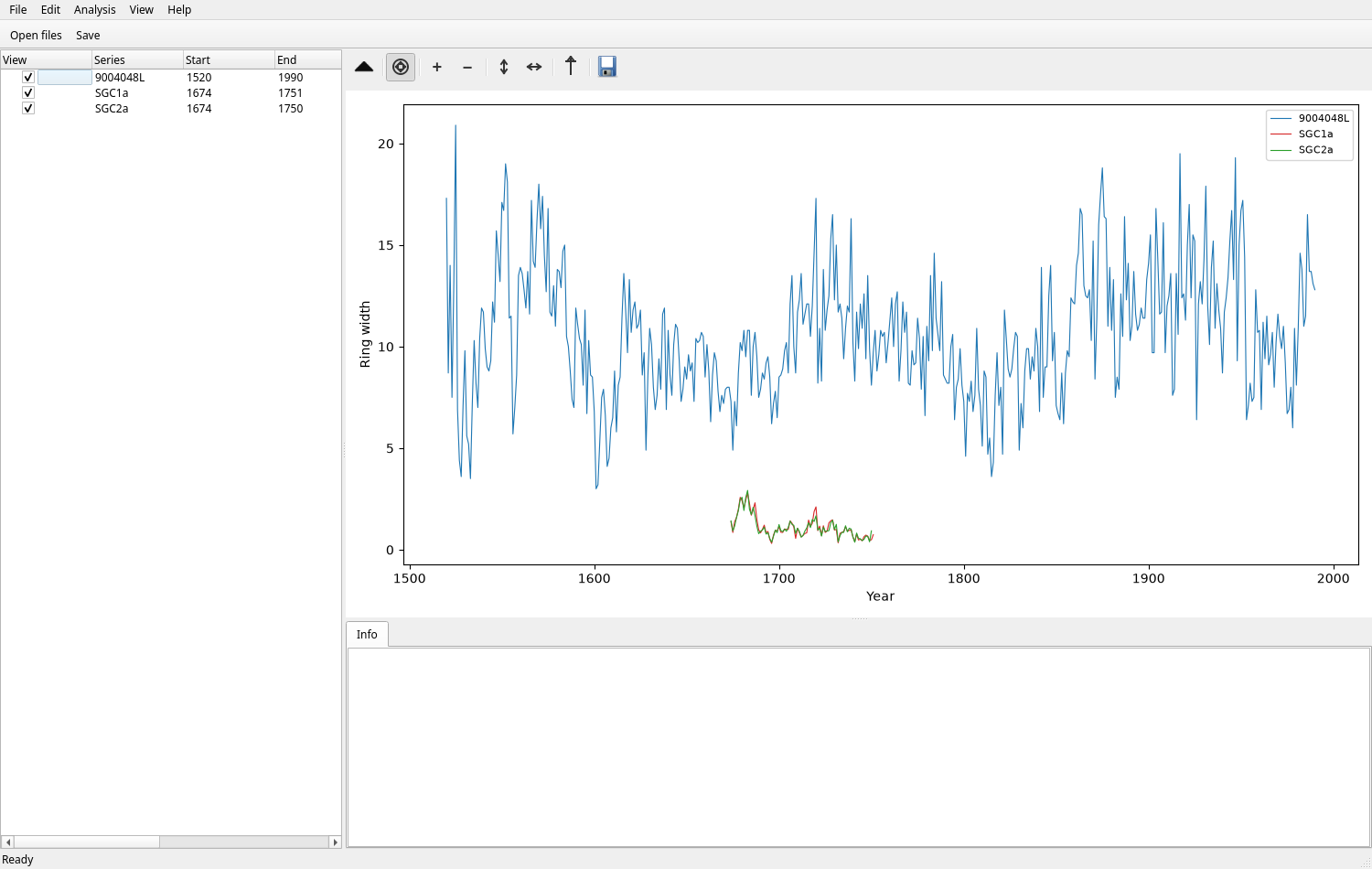
DendrOS can import the most common formats used in dendrochronology (.rwl, .txt and .fh, i.e. the CATRAS/Holmes format) and display them in an interactive time-series plot with pan, zoom and a movable year cursor. Series are managed in a tree with View/Edit/Ref/Info columns, and two separate vertical and horizontal zoom tools, inspired by PAST4, let you stretch the plot on a single axis.

The core of the application is cross-dating: DendrOS slides one or more samples against a reference series (or against a master chronology built on the fly) and ranks every possible position with the Baillie-Pilcher t-value (tBP), together with its p-value, the Pearson correlation coefficient and the Gleichläufigkeit percentage. The best offset can then be applied to the series with a click. Beyond cross-dating, DendrOS can build a master chronology by averaging the overlapping series, highlight concordance bands and pointer years (Weiserjahre), and detrend/index the series through the dplPy library (spline, modified negative exponential, Hugershoff, linear, horizontal). The whole session is saved in a readable .dendro project file.

Below, you can see the main window of DendrOS.

The main window of DendrOS, with the series tree on the left and the time-series plot on the right.

DendrOS is already part of the ArcheOS software list, the GitHub project that marks the first step of the ArcheOS revival, in the dendrochronology section. You can find the source code and the user guide on GitHub, while a pre-built Windows executable is generated automatically from the latest commit and published under Releases, so no Python installation is required to try it.

The project is still under active development, so any feedback from colleagues working with dendrochronology is more than welcome.

I hope you find this useful. Have a nice day!


Wednesday, 7 October 2026

Ghostwriter, a Markdown editor to interact with AI

Hi everyone,

A few days ago I added a new entry to the ArcheOS software list, the GitHub project that marks the first step of the ArcheOS revival: Ghostwriter.

Ghostwriter is a free and open-source, distraction-free and themeable Markdown editor for Linux and Windows, recently moved into the KDE project. It provides a live HTML preview and can export to PDF, HTML, ODT and many other formats.

At first glance, a Markdown editor can look like an odd addition to a list of archaeological software. Actually, nowadays a growing part of our notes, reports and prompts are written in Markdown and produced together with AI agents: Ghostwriter is the application I use to read and edit those .md files, checking them with the live preview before committing them to a repository or sharing them with the team. In other words, it is the missing piece between the AI and our archaeological documents.

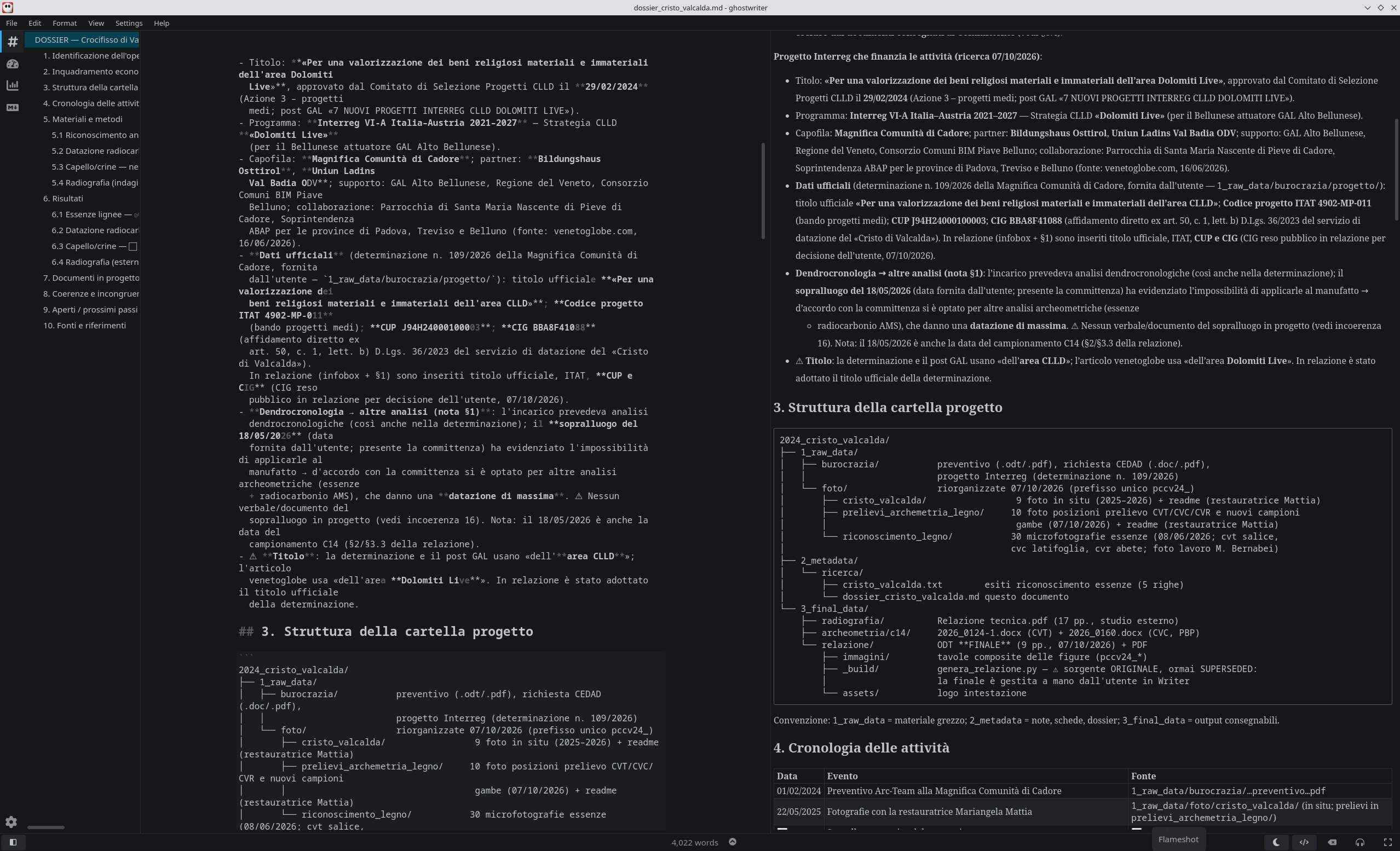
Below, you can see Ghostwriter during the archeometric study of the Cristo di Valcalda.

Use of Ghostwriter during the archeometric study of the Cristo di Valcalda.

For this reason, I have officially added Ghostwriter to the ArcheOS software list, both in the AI agents section and in the Utilities one. One more good reason: Ghostwriter is available in the Debian repositories, which is good news for the next steps of the ArcheOS roadmap.

I hope you find this useful. Have a nice day!


BlogItalia - La directory italiana dei blog Creative Commons License
This work is licensed under a Creative Commons Attribution 4.0 International License.