Saturday, 12 September 2026

Preserving the Past: Ötzi's Digital Twin

 Hello everyone,

Our article regarding the 3D documentation of Ötzi and the archaeological artifacts found with him has been published in the scientific journal Heritage. The open-access paper can be read and downloaded directly from the journal's website or on ResearchGate .

I had previously teased a few of these topics here on ATOR—such as developing a 3DHOP extension to view the mummy in X-ray mode and utilizing the open-source DCMTK libraries to analyze DICOM data from CT scans. However, the new paper details the project's specific challenges and the solutions adopted.


In particular, the article explains:

  •     How we achieved higher detail in surveying leather artifacts using Displacement Mapping, a technique we first experimented with during the Forensic Facial Approximation (FFA) of Santa da Genova;
  •     How we overcame challenges related to specular reflections on non-Lambertian surfaces;
  •     How, in the case of the bear-fur cap, we applied neural radiance fields (NeRF) algorithms using the open-source software nerfstudio;
  •     How we reconstructed a multimodal Digital Twin of Ötzi, capable of simultaneously displaying both the mummy’s 3D surface model (obtained via SfM) and the internal skeletal structure (derived from CT DICOM data).


The seeds of this research were presented in Turin during ArcheoFOSS 2023, but this paper expands significantly on the methodologies developed throughout the Ötzi project.


As always, all software tools used in this work are FLOSS. You can also read the official press release from the South Tyrol Museum of Archaeology here.


I hope you find the article useful. Have a nice day!


Monday, 11 May 2026

DCMTK, a collection of libraries for DICOM standard

 Hi everyone,

As mentioned in my previous post, I’ve been working on a paper regarding our 3D documentation of the Similaun Mummy (Ötzi) and his equipment. During this project (conducted between 2022 and 2024), we processed DICOM data from the CT scan performed by the South Tyrol Health Care Service (Azienda Sanitaria dell'Alto Adige / Südtiroler Sanitätsbetrieb) in 2021.


To extract the CT scan metadata, Alessandro Bezzi identified an excellent FLOSS tool that worked perfectly for our needs: DCMTK.


DCMTK is a comprehensive collection of libraries and applications implementing large parts of the DICOM standard. Below, you can see a screenshot of the shell output showing the metadata of the .dcm image we analyzed.


I believe this is an incredibly useful application for anyone working in mummy studies and beyond. For this reason, I have officially added DCMTK to the ArcheOS software list, which you can find here: https://github.com/lucaarcteam/ArcheOS-software-list/blob/main/software/dicom.md.

I hope you find this useful. Have a nice day!

Sunday, 3 May 2026

3DHOP X-Ray Tool


Hi everyone,

Lately, I’ve been working on a scientific paper regarding one of our past projects from 2023: the 3D documentation of the Similaun Mummy (Ötzi) via SfM (Structure from Motion). The project was carried out on behalf of the South Tyrol Museum of Archaeology and was presented on August 14, 2025, in Peru at the XI World Congress on Mummy Studies in Cuzco, as you can see in the official post of the Museum. For those interested, I’m including links to some news coverage regarding our presentation below (RAI-TGR, Archaeologie on line, Der Standard).

As part of this project, once we obtained the 3D model of Ötzi, we decided to integrate it with DICOM data from the latest CT scans. To achieve this, I used the open-source software InVesalius to automatically extract the 3D model of the skeleton, and 3DHOP to visualize both 3D models (mummy and skeleton) together.

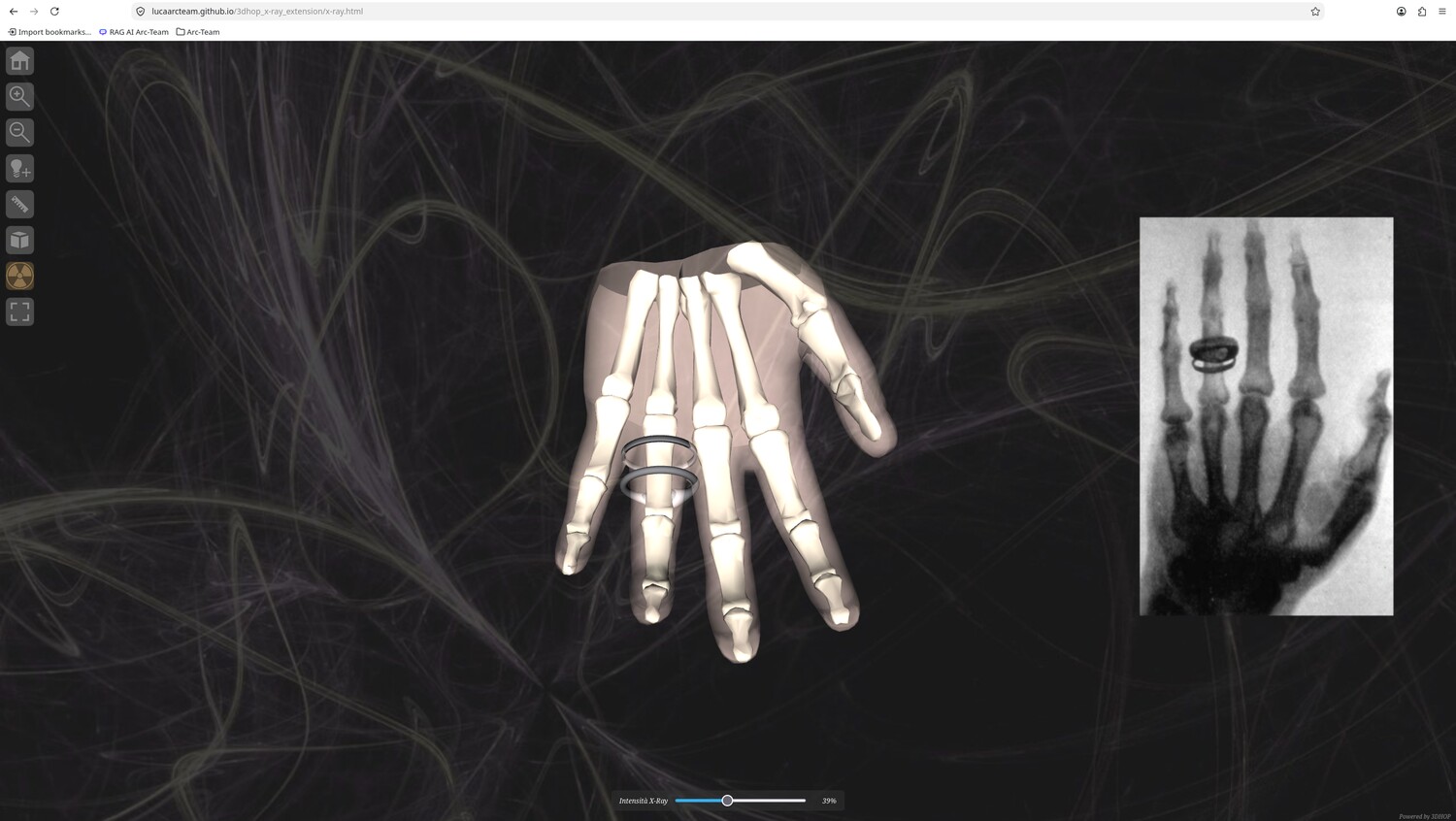
To allow the skeleton model to be viewed within the mummy model in 3DHOP, I utilized the excellent existing "Plane Sections" tool, but I also developed a new tool called "x-ray". This tool manipulates the transparency of the upper layer (the mummy) to reveal the internal layer (the skeleton).


The 3DHOP x-ray extension I developed for the project.

I realized that, due to time constraints, I had never shared the code for this tool. I’ve now corrected that by creating a small GitHub repository, which you can find here: https://github.com/lucaarcteam/3dhop_x-ray_extension.

I hope this post proves useful to the community.

Have a nice day!

Monday, 9 March 2026

R_evolution: a small webapp to explain Human Evolution

 In 2023 I was invited to give a lecture on human evolution at our local high school (Liceo Bertrand Russell). In that occasion I developed a digital presentation with the open source tool impress.js and Strut, using the open material of the exhibition "Facce. I molti volti della storia umana" and integrating a webapp done with Odyssey.jso create an interactive journey through hominid fossils, linking their geographical locations with the forensic facial reconstructions we realized at Arc-Team.

Fast forward to today: I had to give the same lesson, so I decided to dust off that old project, but as often happens with "vintage" web code, it was broken.

The Power of Open Source AI

To bring the project back to life, I experimented with OpenCode, an Open Source AI application. The process was surprisingly smooth; the AI helped me refactor the legacy code and fix the dependencies that had broken over the years.

This sparked an idea: why keep this resource on a local drive when it can still serve a purpose?

Introducing "r_evolution"

I’ve created a new GitHub repository called r_evolution. It’s a simple, functional web app where you can explore the map of human evolution and see the facial reconstructions of our ancestors.

A Call for Collaboration

Currently, the app is in Italian, as it was born for a local context. However, in the spirit of Open Research, I would love for the community to help:

  1. Translate the content into English (or other languages).

  2. Update the data with newer fossil discoveries.

  3. Improve the code for better mobile compatibility.

It was great to see students engaging with these reconstructions once again. It’s a reminder that Open Source isn't just about the tools we use today, but about the "digital stratigraphy" we leave behind—and how easy it is to revive it when the foundations are open.

Stay Open and have a nice day!


The r_evolution webapp


Sunday, 21 December 2025

The OpArc Project at the SFSCON

Hello everyone, 

this short post is to let anyone interested know that our presentation at SFSCON, held in Bolzano/Bozen at the NOI Techpark, has been published online. SFSCON stays for SFSCON stands for South Tyrol Free Software Conference and is one of Europe's most established annual conferences on Free Software.

This year we at Arc-Team decided to participate with a talk that summarized our approximately 20 years of experience in applying the Open Source philosophy to archaeology (both in the software and hardware fields).

The presentation was titled "Arc-Team and the OpArc Project" and can be viewed both on the conference's official website (where you can also download a PDF version) and on the conference's YouTube channel

I hope the presentation can be interesting for someone. Have a nice day! 

Tuesday, 18 February 2025

Reviving ArcheOS

 Hello everyone!

A while ago, I attended the ArcheoFOSS conference held at the University G.D'Annunzio of Chieti-Pescara (December 19-20, 2024). Unfortunately, due to being engaged in a project in Trentino, I couldn't stay long and only followed a few contributions. I plan to discuss my impressions of the workshop and my presentation on CesiumJS in another post. However, in this post, I want to talk about something that somewhat surprised me: people approaching me during breaks to ask why Arc-Team isn't releasing updated versions of ArcheOS anymore (here an article about its first release, back in 2005).

I regret to say that maintaining a GNU/Linux distribution dedicated to archaeology is quite challenging, and after several years, we at Arc-Team couldn't keep the project going. We felt it might be obsolete because many of the software we compiled and prepared for our distribution had become multi-platform or were already packaged for many GNU/Linux distributions, including Debian, which was the base for the latest versions of ArcheOS. Moreover many applications, including Arc-Team Manager, which we use to manage archaeological projects, now run on the server side.

However, according to the people I talked to at the workshop, ArcheOS was still useful not only for those who had trouble compiling specific software but also for anyone wanting a comprehensive overview of selected software for archaeology. This made me realize that ArcheOS could still be a valuable resource, so I decided to try reviving it, though I'm not under any illusions that it will be an easy process or guaranteed to succeed. 

Here's my roadmap:

  1. Create a small GitHub project for a software list for ArcheOS.
  2. Check the status of the software and compile and package any missing ones.
  3. Create a new version of ArcheOS.

I'm currently working on the first step. If you'd like to help or are simply interested in the project, here are some links to check out:

ArcheOS-software-list (GitHub project)

Discussion on ResearchGate 

Thank you for your attention, any help is appreciated! 

Have a nice day!

Monday, 29 January 2024

Enhancement of Hidden Cultural Heritage: The Submerged Forest of Lake Tovel

Hello everyone,

I would have liked to write this post long ago, but I couldn't find the time. As many of you know, Arc-Team has been involved in the study of the submerged forest of Lake Tovel since 2005 (a project started by prof. Tiziano Camagna). For years, especially since we started using 360° cameras, I have been thinking about how to make this hidden cultural heritage accessible even to those who cannot dive (the lake is in a natural park and special permits are required for diving, usually issued for scientific research purposes). The main problem with 360° cameras for underwater shooting was the lack of custom waterproof housings. I had even reached the point of designing one, but fortunately, the company Isnta360 began producing underwater waterproof housings for its models. Finally, a couple of years ago, we had the opportunity to test this technology underwater, thanks to a commission received from APT Val di Non. After some dives, we managed to obtain a good 360° video of the submerged forest. For this first step, the main difficulties were finding optimal conditions for diving. In fact, there are many variables that can influence visibility in mountain lakes. Firstly, there is the weather factor: recent precipitation, even of low intensity, can stir up the upper layer of silt deposited on the lake bottom, which thus goes into suspension and adds to the clay (practically always dissolved in the water), significantly lowering underwater visibility. Secondly, the seasonal aspect should also be considered: cold seasons generally guarantee better visibility, but obviously in winter the lake freezes and the access road is covered with a thick layer of snow. Finally, the diving route should be evaluated. Following some tests with our Insta360 One X 2, we saw that, at Lake Tovel (with good visibility conditions), we should not descend below 20 - 22 meters, otherwise the light in the shots tended excessively towards the blue-green hue and there were no underwater amber filters yet to correct this issue in this type of cameras.

However, in the end, we managed to obtain a good 360° underwater video, which, adjusted through the open-source software KDEnlive, was finally edited and uploaded to YouTube at this address.


Generally, YouTube automatically recognizes this type of footage, but perhaps because it was edited in KDEnlive, this time it didn't work, so I had to inject the 360 metadata into the mp4 format. There are various options for doing this, including the open-source software spatial-media. Once the issue was fixed, YouTube (and other video platforms) was able to "understand" that it was a 360 video and uploaded it accordingly (also activating the option of stereo viewing, in case you intend to enjoy the video through Virtual Reality headsets).

From the same footage, I was also able to extract some 360° panoramas of various Points Of Interest (POIs), in order to create, through the open-source software Marzipano, a specific App, which was then uploaded to the APT Val di Non website at this link. Below, you can see a screenshot of the App.


I hope the post is useful. Have a nice day!

BlogItalia - La directory italiana dei blog Creative Commons License
This work is licensed under a Creative Commons Attribution 4.0 International License.