Sunday, 11 October 2026

3DHOP x-ray tool 2.0

Hi everyone,

Last May I released the x-ray tool, a small extension for 3DHOP I had developed during the 3D documentation project of the Similaun mummy (Ötzi). It loads two aligned meshes of the same subject, an outer surface and an inner structure, and lets you make the outer one semi-transparent, so that what is inside becomes visible without moving the camera. In the first version the effect was a simple on/off toggle.

I have just published version 2.0, which turns that toggle into a real-time control. A new x-ray intensity slider, at the bottom centre of the viewer, regulates the transparency of the outer shell continuously, from an almost invisible shell to a dense "ghost"; the value used on the Ötzi project, 0.9, is still the default, and the toolbar button remains as an on/off shortcut. Version 2.0 also adds the standard 3DHOP measure tool, calibrated in millimetres.

To make the tool easier to try, the repository now includes a live demo on GitHub Pages: lucaarcteam.github.io/3dhop_x-ray_extension/x-ray.html. The demo subject is a left hand with two rings, a homage to Wilhelm Röntgen's first radiograph (Hand mit Ringen, 1895): you can orbit the model, switch the x-ray on and drag the slider to see the bones appear through the skin in real time.

Below, you can see the live demo of the x-ray tool 2.0.
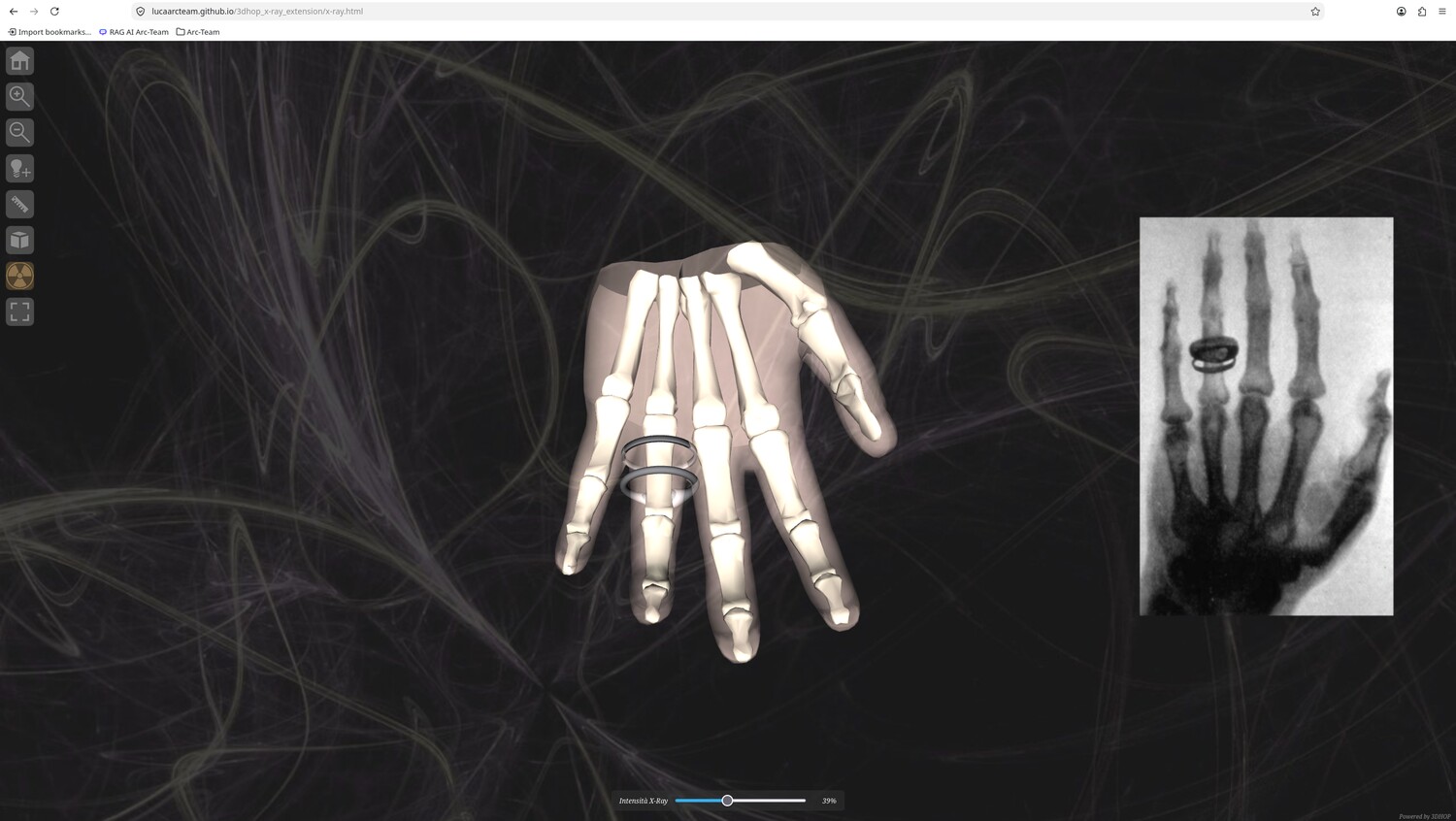
The x-ray tool 2.0 live demo: the Röntgen hand, with the x-ray slider and the skeleton visible through the skin.

Everything runs in the browser with static files, with no server-side code. As in the first version, the 3DHOP core is left untouched: all the extension logic lives in the x-ray.html page and uses the native transparency API, so the tool keeps working with upstream 3DHOP. The code is released under GPL-3.0-or-later, while the demo models come from the open Z-Anatomy atlas (CC BY-SA 4.0).

You can find the source code, the live demo and the release notes on GitHub. The tool was born within the study published in Heritage 2026.

I hope you find this useful. Have a nice day!


Saturday, 10 October 2026

DendrOS, an open-source dendrochronology software

Hi everyone,

Together with Mauro Bernabei (CNR-IBE, the Institute of BioEconomy of the Italian National Research Council), I have been developing a new piece of open-source software for our field: DendrOS.

DendrOS is a cross-platform application for dendrochronological analysis and cross-dating of tree-ring width series. It is written in Python with a PyQt6 interface and released under the GNU General Public License v3, so it runs on Linux and Windows and can be read, modified and redistributed like the rest of our Arc-Team tools.

The project started from a practical need. Many dendrochronologists still rely on PAST4 or PAST5. They are solid reference software, but closed-source and Windows-only, and they no longer fit the open workflow we built around our other projects. DendrOS aims to bring the same working method into the open-source world.

DendrOS can import the most common formats used in dendrochronology (.rwl, .txt and .fh, i.e. the CATRAS/Holmes format) and display them in an interactive time-series plot with pan, zoom and a movable year cursor. Series are managed in a tree with View/Edit/Ref/Info columns, and two separate vertical and horizontal zoom tools, inspired by PAST4, let you stretch the plot on a single axis.

The core of the application is cross-dating: DendrOS slides one or more samples against a reference series (or against a master chronology built on the fly) and ranks every possible position with the Baillie-Pilcher t-value (tBP), together with its p-value, the Pearson correlation coefficient and the Gleichläufigkeit percentage. The best offset can then be applied to the series with a click. Beyond cross-dating, DendrOS can build a master chronology by averaging the overlapping series, highlight concordance bands and pointer years (Weiserjahre), and detrend/index the series through the dplPy library (spline, modified negative exponential, Hugershoff, linear, horizontal). The whole session is saved in a readable .dendro project file.

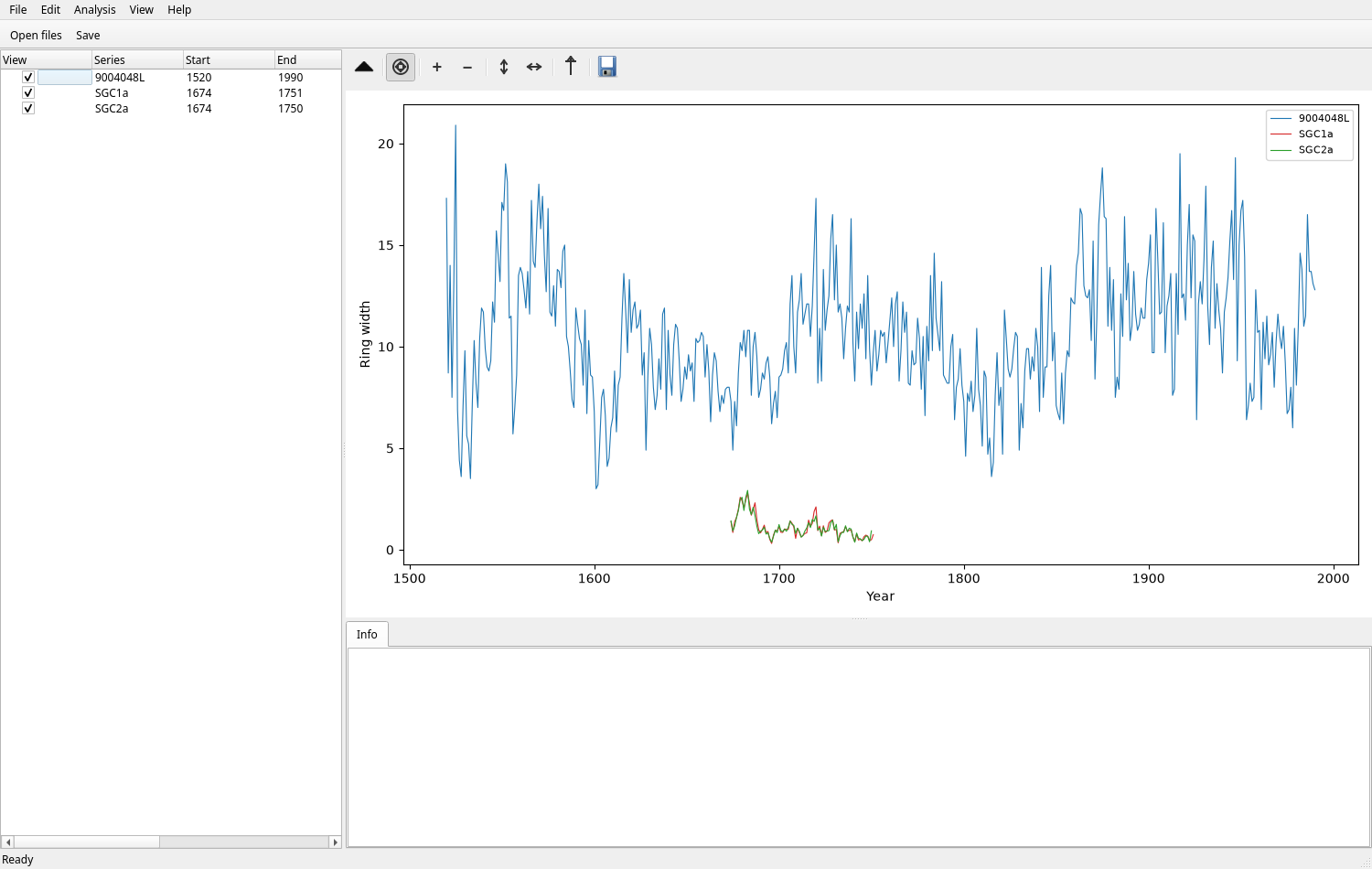
Below, you can see the main window of DendrOS.

The main window of DendrOS, with the series tree on the left and the time-series plot on the right.

DendrOS is already part of the ArcheOS software list, the GitHub project that marks the first step of the ArcheOS revival, in the dendrochronology section. You can find the source code and the user guide on GitHub, while a pre-built Windows executable is generated automatically from the latest commit and published under Releases, so no Python installation is required to try it.

The project is still under active development, so any feedback from colleagues working with dendrochronology is more than welcome.

I hope you find this useful. Have a nice day!


Wednesday, 7 October 2026

Ghostwriter, a Markdown editor to interact with AI

Hi everyone,

A few days ago I added a new entry to the ArcheOS software list, the GitHub project that marks the first step of the ArcheOS revival: Ghostwriter.

Ghostwriter is a free and open-source, distraction-free and themeable Markdown editor for Linux and Windows, recently moved into the KDE project. It provides a live HTML preview and can export to PDF, HTML, ODT and many other formats.

At first glance, a Markdown editor can look like an odd addition to a list of archaeological software. Actually, nowadays a growing part of our notes, reports and prompts are written in Markdown and produced together with AI agents: Ghostwriter is the application I use to read and edit those .md files, checking them with the live preview before committing them to a repository or sharing them with the team. In other words, it is the missing piece between the AI and our archaeological documents.

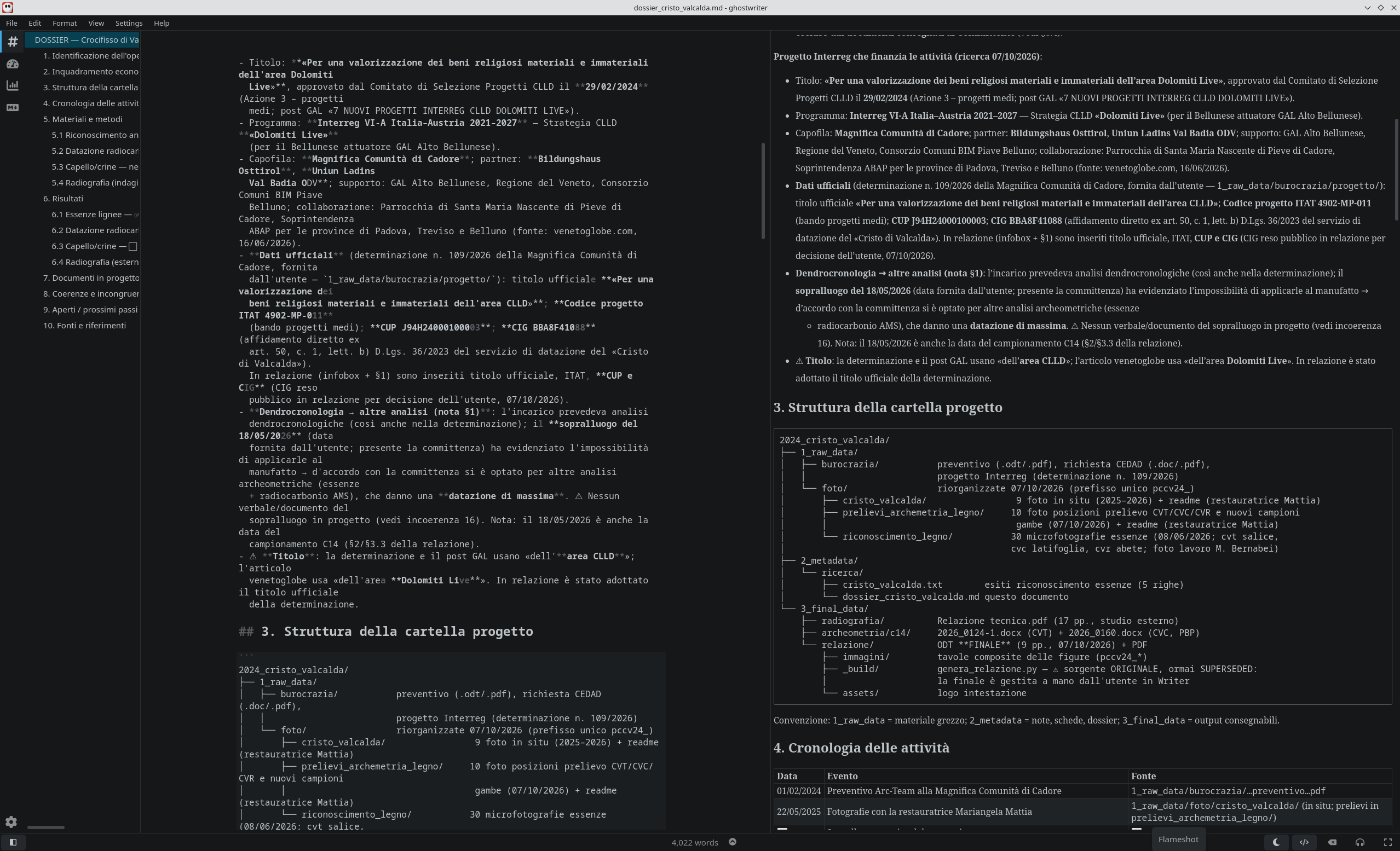
Below, you can see Ghostwriter during the archeometric study of the Cristo di Valcalda.

Use of Ghostwriter during the archeometric study of the Cristo di Valcalda.

For this reason, I have officially added Ghostwriter to the ArcheOS software list, both in the AI agents section and in the Utilities one. One more good reason: Ghostwriter is available in the Debian repositories, which is good news for the next steps of the ArcheOS roadmap.

I hope you find this useful. Have a nice day!


Saturday, 12 September 2026

Preserving the Past: Ötzi's Digital Twin

 Hello everyone,

Our article regarding the 3D documentation of Ötzi and the archaeological artifacts found with him has been published in the scientific journal Heritage. The open-access paper can be read and downloaded directly from the journal's website or on ResearchGate .

I had previously teased a few of these topics here on ATOR—such as developing a 3DHOP extension to view the mummy in X-ray mode and utilizing the open-source DCMTK libraries to analyze DICOM data from CT scans. However, the new paper details the project's specific challenges and the solutions adopted.


In particular, the article explains:

  •     How we achieved higher detail in surveying leather artifacts using Displacement Mapping, a technique we first experimented with during the Forensic Facial Approximation (FFA) of Santa da Genova;
  •     How we overcame challenges related to specular reflections on non-Lambertian surfaces;
  •     How, in the case of the bear-fur cap, we applied neural radiance fields (NeRF) algorithms using the open-source software nerfstudio;
  •     How we reconstructed a multimodal Digital Twin of Ötzi, capable of simultaneously displaying both the mummy’s 3D surface model (obtained via SfM) and the internal skeletal structure (derived from CT DICOM data).


The seeds of this research were presented in Turin during ArcheoFOSS 2023, but this paper expands significantly on the methodologies developed throughout the Ötzi project.


As always, all software tools used in this work are FLOSS. You can also read the official press release from the South Tyrol Museum of Archaeology here.


I hope you find the article useful. Have a nice day!


Monday, 11 May 2026

DCMTK, a collection of libraries for DICOM standard

 Hi everyone,

As mentioned in my previous post, I’ve been working on a paper regarding our 3D documentation of the Similaun Mummy (Ötzi) and his equipment. During this project (conducted between 2022 and 2024), we processed DICOM data from the CT scan performed by the South Tyrol Health Care Service (Azienda Sanitaria dell'Alto Adige / Südtiroler Sanitätsbetrieb) in 2021.


To extract the CT scan metadata, Alessandro Bezzi identified an excellent FLOSS tool that worked perfectly for our needs: DCMTK.


DCMTK is a comprehensive collection of libraries and applications implementing large parts of the DICOM standard. Below, you can see a screenshot of the shell output showing the metadata of the .dcm image we analyzed.


I believe this is an incredibly useful application for anyone working in mummy studies and beyond. For this reason, I have officially added DCMTK to the ArcheOS software list, which you can find here: https://github.com/lucaarcteam/ArcheOS-software-list/blob/main/software/dicom.md.

I hope you find this useful. Have a nice day!
Sunday, 3 May 2026

3DHOP X-Ray Tool


Hi everyone,

Lately, I’ve been working on a scientific paper regarding one of our past projects from 2023: the 3D documentation of the Similaun Mummy (Ötzi) via SfM (Structure from Motion). The project was carried out on behalf of the South Tyrol Museum of Archaeology and was presented on August 14, 2025, in Peru at the XI World Congress on Mummy Studies in Cuzco, as you can see in the official post of the Museum. For those interested, I’m including links to some news coverage regarding our presentation below (RAI-TGR, Archaeologie on line, Der Standard).

As part of this project, once we obtained the 3D model of Ötzi, we decided to integrate it with DICOM data from the latest CT scans. To achieve this, I used the open-source software InVesalius to automatically extract the 3D model of the skeleton, and 3DHOP to visualize both 3D models (mummy and skeleton) together.

To allow the skeleton model to be viewed within the mummy model in 3DHOP, I utilized the excellent existing "Plane Sections" tool, but I also developed a new tool called "x-ray". This tool manipulates the transparency of the upper layer (the mummy) to reveal the internal layer (the skeleton).


The 3DHOP x-ray extension I developed for the project.

I realized that, due to time constraints, I had never shared the code for this tool. I’ve now corrected that by creating a small GitHub repository, which you can find here: https://github.com/lucaarcteam/3dhop_x-ray_extension.

I hope this post proves useful to the community.

Have a nice day!

Monday, 9 March 2026

R_evolution: a small webapp to explain Human Evolution

 In 2023 I was invited to give a lecture on human evolution at our local high school (Liceo Bertrand Russell). In that occasion I developed a digital presentation with the open source tool impress.js and Strut, using the open material of the exhibition "Facce. I molti volti della storia umana" and integrating a webapp done with Odyssey.js, o create an interactive journey through hominid fossils, linking their geographical locations with the forensic facial reconstructions we realized at Arc-Team.

Fast forward to today: I had to give the same lesson, so I decided to dust off that old project, but as often happens with "vintage" web code, it was broken.

The Power of Open Source AI

To bring the project back to life, I experimented with OpenCode, an Open Source AI application. The process was surprisingly smooth; the AI helped me refactor the legacy code and fix the dependencies that had broken over the years.

This sparked an idea: why keep this resource on a local drive when it can still serve a purpose?

Introducing "r_evolution"

I’ve created a new GitHub repository called r_evolution. It’s a simple, functional web app where you can explore the map of human evolution and see the facial reconstructions of our ancestors.

A Call for Collaboration

Currently, the app is in Italian, as it was born for a local context. However, in the spirit of Open Research, I would love for the community to help:

  1. Translate the content into English (or other languages).

  2. Update the data with newer fossil discoveries.

  3. Improve the code for better mobile compatibility.

It was great to see students engaging with these reconstructions once again. It’s a reminder that Open Source isn't just about the tools we use today, but about the "digital stratigraphy" we leave behind—and how easy it is to revive it when the foundations are open.

Stay Open and have a nice day!


The r_evolution webapp


BlogItalia - La directory italiana dei blog Creative Commons License
This work is licensed under a Creative Commons Attribution 4.0 International License.