Sunday, 24 March 2013

Extreme SfM: underwater archaeology

Hi all,
It is long that Alessandro and me wanted to write this post, but for one reason or another, we could not work on it. 
Today I decided to do it in order to answer two questions that people often asked us during conference or lessons:

1) Is it possible to work with SfM/IBM techniques underwater?

2) Is it possible to extract 3D from a movie?

As regards the first question, I can report that since we (Arc-Team) started to work with SfM and IBM (2009), we did also tests underwater and they gave us positive results. This is one of the main reason why we invested so much time on the research in this filed: SfM and IBM methodology, until now, is one of the best solution in archeology, due to its versatility (it can be used for underwater or aerial documentation, in low light conditions or in precarious situation, during mission abroad, etc...). We already underlined this concept when, with the help of Nicolò Dell'unto (Lund University), we compared different methodology to record 3D documentation of archaeological artifacts. The result of this experiment was presented during the ArcheoFOSS 2012, in Napoli (see the related slides and this post). During the workshop "Low cost 3D: sensori, algoritmi e applicazioni", we had the opportunity to better analyze the use of SfM/IBM in extreme working conditions, strengthening our point of view about this methodology (see the related slides). 
The image below is an example of an aerial 3D documentation done with an open source UAV and Python Photogrammetry ToolboX...


Aerial documentation with a KKopter and ArcheOS (PPT)
... while this other image shows the results we achieved using some pictures that Victor Jansa, of TUWA ("Tauchverein für Unterwasserarchäologie"), sent us to do a test.


Test with Victor Jansa's pictures (done with PPT)

In order to answer the second question, I can say that, facing our experience, it is possible to reconstruct 3D models from videos (and I guess this is one of the aims of SfM itself). We did some tests about this topic, getting acceptable result (at least regarding our primary target, which was to have a fast 3D object for further modeling operations). As an example, I can report one of the last post of Cicero Moraes, who used SfM from a youtube clip to get a 3D skull for forensic facial reconstruction aims. The image below is taken from Cicero's photo album:


3D skull obtained with SfM techniques from a movie

For a better explanation of what I wrote above, I think it is worth to show the results of a project we are undertaking since 2005 (trying to support Prof. Tiziano Camagna on his exploration of Tovel's Lake, in Trentino).  During this project we did several surveys, diving in different parts of the lake and especially in the South-West area, where lies a forest which is now underwater. In 2012 Tiziano Camagna and Andrea Forti, despite the low visibility, where able to record a short movie of some of the threes. We used this video for a fast 3D reconstruction, because it was particularly indicated, due to its characteristics: it was recorded for no SfM aims (as you see the movie sequences are not optimal for a 3D reconstruction), it represents the normal turbidity condition of the lake and it was done with an high lens distortion camera (GoPro Hero 2). For such reasons this material was perfect to hardly test SfM and IBM techniques for underwater archeology. In this animation you can see a short part of the movie (from the 15th second  to the 25th), which we used for the 3D documentation...

From "La foresta sommersa del Lago di Tovel" (T. Camagna, A. Forti)

... and here you can see the result:


I hope this post was useful. Soon, when the season will allow us to start diving again, we will go on with tests and experiment related with underwater archeology. I hope to write soon some new report about it.


Friday, 22 March 2013

Tothmea - the Egyptian mummy in Brazil


In May 18 will happen in Egyptian and Rosicrucian Museum in the city of Curitiba, Brazil, the "Feliz Dia da Múmia 2" (Mummy's Happy Day 2).

This will be a conference about Tothmea, an Egyptian mummy exposed on the same museum.


The archaeologist Dr. Moacir Elias Santos, will talk about the history of the mummy. Starting with her coming from Egypt, the passage arounf USA until the arrive to Brazil.


And I'll talk about the process of forensic facial reconstruction using almost only free software (we had to use 123D Catch because I still had not mastered the PPT).


This is the first time a mummy reconstructed from this team is formally exposed.

So, I let here my invitation to you.

A big hug!

Wednesday, 20 March 2013

Converting a video into a 3D mesh and reconstructing a face


The technology of SfM allow you convert, with great precision and quality, some photos into a 3D mesh.

The problem is when you don't have the photos and need to find other ways to reconstruct an object.

Fortunatelly, the Python Photogrammetry Toolbox (SfM) works well in a couple of possibilities, and like you saw in the video above, also with this type of media.


The video downloaded, shows the Budapest Múmia Projekt of the Szépművészeti Múzeum.

This project was a multidisciplinary effort not only to reconstruct the face of the mummies, but the panorama of their past lifes too.

To put the object in the scale, I use other video that show the CT-Scan with a scale at side.

Even working with a low quality reconstructed mesh, the result of the reconstruction was relatively compatible with the oficial bust made by Dr. Kustár Ágnes.

If you wanna see the step-by-step of the process, I created an album and shared it here: https://plus.google.com/photos/115430171389306289690/albums/5856903432134303473

I hope you enjoy.

A big hug and I see you in the next!


Saturday, 16 March 2013

The Faces of Evolution - Exhibition of hominids forensic facial reconstructions


May 18th through July 31st, 2013 will happen in the big and beautiful Curitiba city in Brazil, the exhibition The Faces of Evolution.

Near the replicas of skull of hominids will have nine panels with forensic facial reconstructions.

The exhibition will happen now, but the history started here in ATOR some months ago.

The methodology developed to model the majority of the faces was used for the very first time in Alberto di Trento's reconstruction.


On that occasion the Arc-Team presented a paper at the event Giovani Antropology (Italy), where they described the methodology for forensic facial reconstruction using only free software.


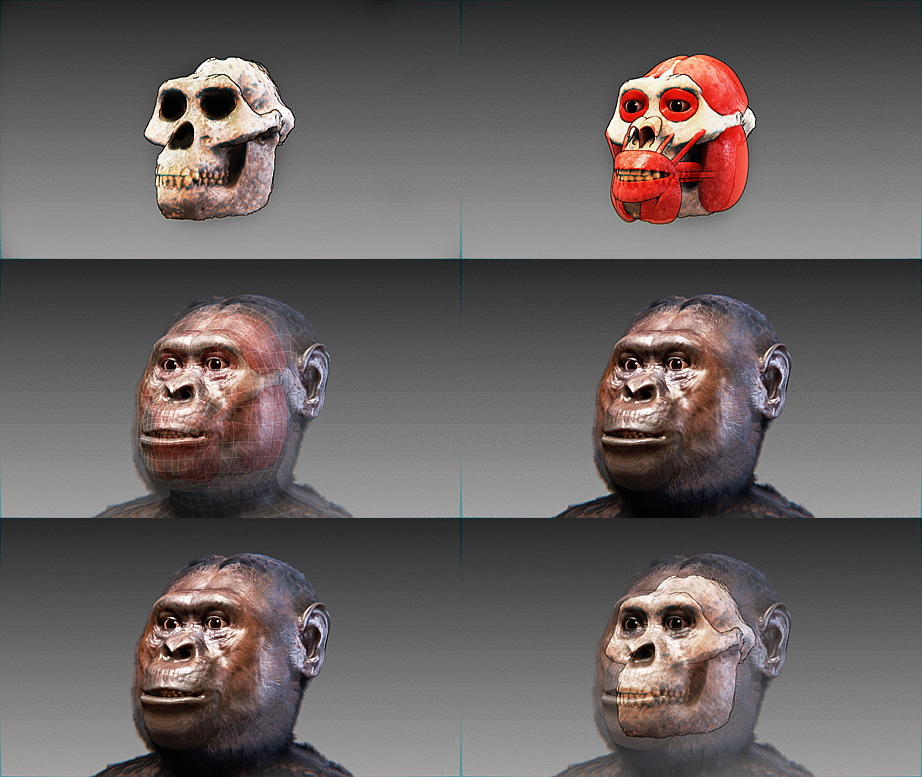
Following the events, we initiated Project Taung. If before we had rebuilt a modern human this time we would rebuild a hominid remote, then the Taung Child.

Beyond the Arc-Team Group, has joined the project Prof. Dr. Nicola Carrara University of Padua.


We were able to reconstruct the face of the Taung child fastly, thanks to a methodology developed previously.

We had a largely positive feedback, both personalities linked to forensic facial reconstruction, as those related to 3D modeling, as the creator of  Blender, Mr. Ton Roosendaal.


Several media outlets broadcasted stories (see the comments) on the reconstruction of the Taung child, as the Jornal de Brasilia above.

After the successful reconstruction of hominid remote, we got in touch with the archaeologist Prof. Dr. Moacir Elias Santos of the Archaeological Museum of Ponta Grossa and Prof. Esp. Vivian Tedardi of Rosicrucian and Egyptian Museum in Brazil and we began a series of modeling which culminated in the exhibition the Faces of Evolution, described here.


The Cro-Magnon man.

The Turkana Boy.

The Homo heildelbergensis.

The Homo neanderthalensis.

The Homo habilis.


And last but not least, the Homo floresiensis.


This was a brief description of the exhibition and its history. Now, we expect the event date arrives, while others look for fossils to be rebuilt.

A big hug!

Friday, 15 March 2013

AnthropoloG+

Hi all,
this post is nothing serious, maybe just fun, but somehow interesting. 
Today I was reading last post of Cicero Moraes in G+; it regards an exposition about about evolutionary anthropology which will soon take place in Brazil. I will not write about this exposition here, because I hope that Cicero will do a post in the next days, but I want to report what I noticed when I loaded the poster of the exhibition in G+ (you can see it in the image below)...

Poster of the exhibition (by Cicero Moraes)
... I knew that G+ added a facial recognition application, so that it is now simpler to find human faces in the user's uploaded pictures, what I did not expected was that G+ tried to recognize the faces inside the exhibition's poster. The result is what you can see in the short clip below:


the Taung Child (Australopithecus africanus), the Australopithecus afarensis and the Homo habilis are not considered human faces by G+. On the contrary, the facial recognition application is able to find the Turkana Boy (Homo erectus), the Homo floresiensis, the Homo erectus pekinensis, the Homo heidelbergensis, the Homo neanderthalensis and, of course, the Cro-Magnon (early Homo sapiens sapiens). 
To verify that the facial recognition was not due to Cicero tags, I downloaded the image and uploaded again on my account and... I get the same result. Moreover, when I uploaded the picture, the software asked me to tag the people of the "photo", recognizing the same six faces, as you can see in the image below.

The facial recognition during uploading process

I do not know if this report can be interesting for an anthropologist; maybe Moreno Tiziani could better analyze this phenomenon, but I just wanted to inform you about this strange anthropological attitude of a social network, let's say this AnthropoloG+ application :).

Tuesday, 12 March 2013

Homo floresiensis - 3D forensic facial reconstruction of the "hobbit"

Second Wikipedia:

Homo floresiensis ("Flores Man", nicknamed "hobbit" and "Flo") is a possible species, now extinct, in the genus Homo. The remains of an individual were discovered in 2003 on the island of Flores in Indonesia. Partial skeletons of nine individuals have been recovered, including one complete cranium (skull).These remains have been the subject of intense research to determine whether they represent a species distinct from modern humans, and the progress of this scientific controversy has been closely followed by the news media at large. This hominin is remarkable for its small body and brain and for its survival until relatively recent times (possibly as recently as 12,000 years ago).


Some months ago a forensic facial reconstruction of the "hobbit" was presented in the web.


I liked very much of this and decided create a version to a exposure about human evolution that will happen here in Brazil.


I was not able to find a 3D reconstructed skull on the web, but fortunately I found two ortogonal rotating video in this link: www-personal.une.edu.au/~pbrown3/ (thank you mr. Peter Brown!)

To reconstruct the skull I converted the videos in a image sequence with FFMPEG:

$ ffmpeg -i Input_video.avi -sameq Output_directory/%04d.jpg

After that I imported ten images in Inkscape and I converted the bitmap in vector (Shift + Alt +B).


So, I placed the "slices" in their positions, and I made a extrusion by rotating.

With this I had the basic shape of the skull to continue, this time, with the sculpting process.


If you wanna see the entire process, please look this album: http://plus.google.com/photos/115430171389306289690/albums/5853884703716365057

If you wanna download the .ply file, visit this link:


I cannot forget to thank Dr. Paulo Miamoto to help me with the modeling of the teeth.

I hope you enjoy.

A big hug and I see you in the next!


Monday, 11 March 2013

CloudCompare: how to georeference a point cloud using data from total station (local coo system)

Hi all,
I made a new videotutorial about rectification using CloudCompare v. 2.4. In this video i use data from total station (local coordinates system) to rectify a point cloud. The point cloud is realized using Python Photogrammetry Toolbox.


BlogItalia - La directory italiana dei blog Creative Commons License
This work is licensed under a Creative Commons Attribution 4.0 International License.