Monday, 11 May 2026

DCMTK, a collection of libraries for DICOM standard

 Hi everyone,

As mentioned in my previous post, I’ve been working on a paper regarding our 3D documentation of the Similaun Mummy (Ötzi) and his equipment. During this project (conducted between 2022 and 2024), we processed DICOM data from the CT scan performed by the South Tyrol Health Care Service (Azienda Sanitaria dell'Alto Adige / Südtiroler Sanitätsbetrieb) in 2021.


To extract the CT scan metadata, Alessandro Bezzi identified an excellent FLOSS tool that worked perfectly for our needs: DCMTK.


DCMTK is a comprehensive collection of libraries and applications implementing large parts of the DICOM standard. Below, you can see a screenshot of the shell output showing the metadata of the .dcm image we analyzed.


I believe this is an incredibly useful application for anyone working in mummy studies and beyond. For this reason, I have officially added DCMTK to the ArcheOS software list, which you can find here: https://github.com/lucaarcteam/ArcheOS-software-list/blob/main/software/dicom.md.

I hope you find this useful. Have a nice day!

Sunday, 3 May 2026

3DHOP X-Ray Tool


Hi everyone,

Lately, I’ve been working on a scientific paper regarding one of our past projects from 2023: the 3D documentation of the Similaun Mummy (Ötzi) via SfM (Structure from Motion). The project was carried out on behalf of the South Tyrol Museum of Archaeology and was presented on August 14, 2025, in Peru at the XI World Congress on Mummy Studies in Cuzco, as you can see in the official post of the Museum. For those interested, I’m including links to some news coverage regarding our presentation below (RAI-TGR, Archaeologie on line, Der Standard).

As part of this project, once we obtained the 3D model of Ötzi, we decided to integrate it with DICOM data from the latest CT scans. To achieve this, I used the open-source software InVesalius to automatically extract the 3D model of the skeleton, and 3DHOP to visualize both 3D models (mummy and skeleton) together.

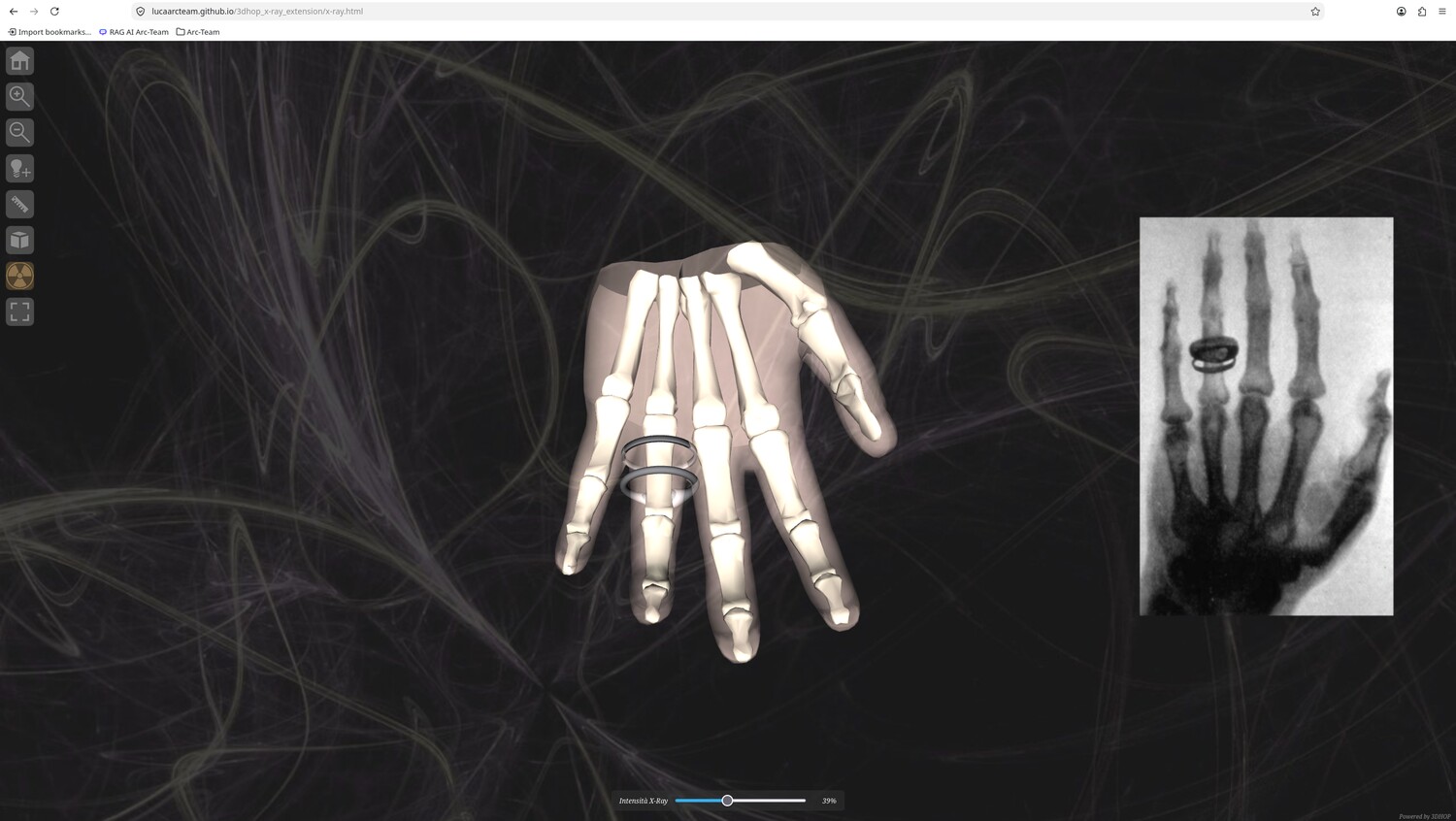
To allow the skeleton model to be viewed within the mummy model in 3DHOP, I utilized the excellent existing "Plane Sections" tool, but I also developed a new tool called "x-ray". This tool manipulates the transparency of the upper layer (the mummy) to reveal the internal layer (the skeleton).


The 3DHOP x-ray extension I developed for the project.

I realized that, due to time constraints, I had never shared the code for this tool. I’ve now corrected that by creating a small GitHub repository, which you can find here: https://github.com/lucaarcteam/3dhop_x-ray_extension.

I hope this post proves useful to the community.

Have a nice day!

Monday, 9 March 2026

R_evolution: a small webapp to explain Human Evolution

 In 2023 I was invited to give a lecture on human evolution at our local high school (Liceo Bertrand Russell). In that occasion I developed a digital presentation with the open source tool impress.js and Strut, using the open material of the exhibition "Facce. I molti volti della storia umana" and integrating a webapp done with Odyssey.jso create an interactive journey through hominid fossils, linking their geographical locations with the forensic facial reconstructions we realized at Arc-Team.

Fast forward to today: I had to give the same lesson, so I decided to dust off that old project, but as often happens with "vintage" web code, it was broken.

The Power of Open Source AI

To bring the project back to life, I experimented with OpenCode, an Open Source AI application. The process was surprisingly smooth; the AI helped me refactor the legacy code and fix the dependencies that had broken over the years.

This sparked an idea: why keep this resource on a local drive when it can still serve a purpose?

Introducing "r_evolution"

I’ve created a new GitHub repository called r_evolution. It’s a simple, functional web app where you can explore the map of human evolution and see the facial reconstructions of our ancestors.

A Call for Collaboration

Currently, the app is in Italian, as it was born for a local context. However, in the spirit of Open Research, I would love for the community to help:

  1. Translate the content into English (or other languages).

  2. Update the data with newer fossil discoveries.

  3. Improve the code for better mobile compatibility.

It was great to see students engaging with these reconstructions once again. It’s a reminder that Open Source isn't just about the tools we use today, but about the "digital stratigraphy" we leave behind—and how easy it is to revive it when the foundations are open.

Stay Open and have a nice day!


The r_evolution webapp


Sunday, 21 December 2025

The OpArc Project at the SFSCON

Hello everyone, 

this short post is to let anyone interested know that our presentation at SFSCON, held in Bolzano/Bozen at the NOI Techpark, has been published online. SFSCON stays for SFSCON stands for South Tyrol Free Software Conference and is one of Europe's most established annual conferences on Free Software.

This year we at Arc-Team decided to participate with a talk that summarized our approximately 20 years of experience in applying the Open Source philosophy to archaeology (both in the software and hardware fields).

The presentation was titled "Arc-Team and the OpArc Project" and can be viewed both on the conference's official website (where you can also download a PDF version) and on the conference's YouTube channel

I hope the presentation can be interesting for someone. Have a nice day! 

Tuesday, 18 February 2025

Reviving ArcheOS

 Hello everyone!

A while ago, I attended the ArcheoFOSS conference held at the University G.D'Annunzio of Chieti-Pescara (December 19-20, 2024). Unfortunately, due to being engaged in a project in Trentino, I couldn't stay long and only followed a few contributions. I plan to discuss my impressions of the workshop and my presentation on CesiumJS in another post. However, in this post, I want to talk about something that somewhat surprised me: people approaching me during breaks to ask why Arc-Team isn't releasing updated versions of ArcheOS anymore (here an article about its first release, back in 2005).

I regret to say that maintaining a GNU/Linux distribution dedicated to archaeology is quite challenging, and after several years, we at Arc-Team couldn't keep the project going. We felt it might be obsolete because many of the software we compiled and prepared for our distribution had become multi-platform or were already packaged for many GNU/Linux distributions, including Debian, which was the base for the latest versions of ArcheOS. Moreover many applications, including Arc-Team Manager, which we use to manage archaeological projects, now run on the server side.

However, according to the people I talked to at the workshop, ArcheOS was still useful not only for those who had trouble compiling specific software but also for anyone wanting a comprehensive overview of selected software for archaeology. This made me realize that ArcheOS could still be a valuable resource, so I decided to try reviving it, though I'm not under any illusions that it will be an easy process or guaranteed to succeed. 

Here's my roadmap:

  1. Create a small GitHub project for a software list for ArcheOS.
  2. Check the status of the software and compile and package any missing ones.
  3. Create a new version of ArcheOS.

I'm currently working on the first step. If you'd like to help or are simply interested in the project, here are some links to check out:

ArcheOS-software-list (GitHub project)

Discussion on ResearchGate 

Thank you for your attention, any help is appreciated! 

Have a nice day!

Monday, 29 January 2024

Enhancement of Hidden Cultural Heritage: The Submerged Forest of Lake Tovel

Hello everyone,

I would have liked to write this post long ago, but I couldn't find the time. As many of you know, Arc-Team has been involved in the study of the submerged forest of Lake Tovel since 2005 (a project started by prof. Tiziano Camagna). For years, especially since we started using 360° cameras, I have been thinking about how to make this hidden cultural heritage accessible even to those who cannot dive (the lake is in a natural park and special permits are required for diving, usually issued for scientific research purposes). The main problem with 360° cameras for underwater shooting was the lack of custom waterproof housings. I had even reached the point of designing one, but fortunately, the company Isnta360 began producing underwater waterproof housings for its models. Finally, a couple of years ago, we had the opportunity to test this technology underwater, thanks to a commission received from APT Val di Non. After some dives, we managed to obtain a good 360° video of the submerged forest. For this first step, the main difficulties were finding optimal conditions for diving. In fact, there are many variables that can influence visibility in mountain lakes. Firstly, there is the weather factor: recent precipitation, even of low intensity, can stir up the upper layer of silt deposited on the lake bottom, which thus goes into suspension and adds to the clay (practically always dissolved in the water), significantly lowering underwater visibility. Secondly, the seasonal aspect should also be considered: cold seasons generally guarantee better visibility, but obviously in winter the lake freezes and the access road is covered with a thick layer of snow. Finally, the diving route should be evaluated. Following some tests with our Insta360 One X 2, we saw that, at Lake Tovel (with good visibility conditions), we should not descend below 20 - 22 meters, otherwise the light in the shots tended excessively towards the blue-green hue and there were no underwater amber filters yet to correct this issue in this type of cameras.

However, in the end, we managed to obtain a good 360° underwater video, which, adjusted through the open-source software KDEnlive, was finally edited and uploaded to YouTube at this address.


Generally, YouTube automatically recognizes this type of footage, but perhaps because it was edited in KDEnlive, this time it didn't work, so I had to inject the 360 metadata into the mp4 format. There are various options for doing this, including the open-source software spatial-media. Once the issue was fixed, YouTube (and other video platforms) was able to "understand" that it was a 360 video and uploaded it accordingly (also activating the option of stereo viewing, in case you intend to enjoy the video through Virtual Reality headsets).

From the same footage, I was also able to extract some 360° panoramas of various Points Of Interest (POIs), in order to create, through the open-source software Marzipano, a specific App, which was then uploaded to the APT Val di Non website at this link. Below, you can see a screenshot of the App.


I hope the post is useful. Have a nice day!

Monday, 22 January 2024

ArcheoFOSS 2023, 17th edition: Torino 2023

Hello everyone.

As you may know, we at Arc-Team are particularly connected to the ArcheoFOSS workshop, a meeting on archaeology and open-source software that we helped found in 2006. Last December, the seventeenth edition took place in Turin (Piedmont, Italy) and, after a couple of years of absence, we were able to participate again. Our presentation was titled "Digital twins of archaeological finds. Open source technologies applied to 3D scanning. Methodologies, limits, and results" and dealt, among other things, with a topic that is very dear to me: how to carry out good 3D archaeological documentations (with open-source software) of artifacts with "difficult" surfaces, such as gold or fur.

Today, I took the time to upload our presentation, of which you can see the initial slide below. You can find our presentation at this address.


Below is a brief summary of the topics covered slide by slide:

SLIDE 1

Simply the title.

SLIDE 2

The institutions involved in the presented projects: MArTA (Museo Archeologico Nazionale di Taranto), Südtiroler Archäologiemuseum - Museo Archeologico dell'Alto Adige, UMST (Unità di Missione Strategica della Provincia Autonoma di Trento), and, of course, Arc-Team.

SLIDE 3

MArTA, perhaps the most important museum in Magna Graecia, famous for its collection of gold items.

SLIDE 4

Südtiroler Archäologiemuseum - Museo Archeologico dell'Alto Adige, famous for hosting the mummy of Ötzi (the Similaun Man).

SLIDE 5

The Autonomous Province of Trento, which, with its offices, is responsible for the conservation and enhancement of Cultural Heritage in Trentino (Italy).

SLIDE 6

Arc-Team: a company specialized in various archaeological sectors, including FFR (Forensic Facial Reconstruction), Field Archaeology, Digital Archaeology, Mission Abroad, Archaeorobotics, Extreme Archaeology, etc...

SLIDE 7

An example of the wide range of artifacts stored at MArTA.

SLIDE 8

An example of the type of artifacts associated with the Similaun Man's mummy (mostly made of natural materials such as wood, leather, fur, etc.).

SLIDE 9

An example of the various types of archaeological projects carried out by Arc-Team in the Autonomous Province of Trentino - Alto Adige/Südtirol.

SLIDE 10

A gallery concerning issues related to 3D documentation of artifacts in the mentioned contexts. Main issues include the size (from very large to very small) of artifacts; logistics (with non-dismountable exhibits, non-detachable display cases, old museum contexts, crowded visitor rooms, etc.); the complexity of some objects (which may require documenting both the internal and external surfaces in 3D, even in the case of very small artifacts); the variability of the characteristics of different surfaces (including extremely reflective ones, such as gold, silver, and sometimes bronze; semi-transparent ones, such as glass; those that absorb light, such as skin and certain types of wood; and very particular ones, such as fur).

SLIDE 11

The solution that Arc-Team prefers for 3D archaeological documentation: SfM (Structure from Motion). In the photo, Alessandro Bezzi, Luca Bezzi, and Kalus Kerkow in front of the TOPOI Excellence Cluster lion in Berlin (Germany), documented in 3D in 2009 with the open-source PPT (Python Photogrammetry Toolbox) software developed by the Frenchman Pierre Moulon.

SLIDE 12

The workflow PPT (now obsolete), which relied on the open-source Bundler and PMVS software.

SLIDE 13

The level of detail/accuracy achieved with PPT in 2009.

SLIDE 14

The current situation in the panorama of open-source SfM software. Among the various options: OpenDroneMap (excellent for archaeological excavation and aerial documentation), openMVG, Regard3D, MicMac (excellent for aerial documentation), orthoBlender (excellent for FFR and any project involving a 3D modeling step), Colmap, openMVS, MeshRoom (excellent in creating and managing raster textures).

SLIDE 15

A slide to show the versatility of a 3D approach based on SfM, capable of operating in extreme contexts (Underwater Archaeology, Aerial Archaeology, Glacial Archaeology, High Mountain Archaeology, Speleoarchaeology), as well as in logistically simpler contexts (Field Archaeology, museums), based on very simple equipment such as a camera, easily usable even during missions abroad.

SLIDE 16

A video of the 3D documentation of a speleoarchaeological context: the Grotta del Teschio, investigated by Arc-Team at the end of 2023 on Monte Stivo (southern Trentino, Italy).

SLIDE 17

Issues of 3D documentation of artifacts related to light: problems due to ambient light and problems due to reflected light.

SLIDE 18

A typical example of 3D documentation problems related to ambient light: underwater documentation (solvable with pre-processing photos through the open-source software ImageMagick). Specifically, the photo shows the example of the Barca dei Diavoli (which I have already talked about in various posts here on ATOR in the past).

SLIDE 19

The 3D reconstruction and vector drawing (from GIS) of the Barca dei Diavoli.

SLIDE 20

Another example of problems arising from ambient light, this time inside a museum (MArta): presence of poorly lit areas; artificial light spots; ambient light (sun) divided into three different entry points from the windows of the wall; presence of large reflective surfaces.

SLIDE 21

Solutions to eliminate or mitigate problems due to ambient light inside museums: dark or reflective panels, special flashes (ring-type), etc.

SLIDE 22

A video showing the example of 3D documentation of a marble head not removable from its museum location. Documentation is carried out through SfM with the help of a ring flash and two LED panels for uniform lighting.

SLIDE 23

Another example of correcting ambient light in a museum (in cases where small objects removable from display locations are documented), through the use of simple photographic boxes.

SLIDE 24

Problems with reflected light and the dynamics of light on reflective surfaces. The first image shows Blender's mascot (Suzanne) in gold, as it would appear in reality, with both diffuse and specular reflection light. The two derived images show, on the left, Suzanne with only diffuse light, and on the right, Suzanne with only specular reflection light. This slide serves to show the technique normally used to document objects with a very reflective surface through SfM: an attempt is made to obtain only photographs with diffuse light (without specular reflection light), from which 3D is then extracted.

SLIDE 25

In some cases, such as bronze, to obtain reflection-free photos, it is sufficient to use a polarizing filter on the camera (and rotate it according to the direction of the reflection). In the example shown in the photo, a bronze helmet kept at MArTA.

SLIDE 26

The 3D result of the helmet from the previous slide.

SLIDE 27

Another example of a complex 3D from MArTA: a semitransparent glass cinerary urn with the amphora in which was housed.

SLIDE 28

An example of 3D with reflected light from organic materials (wood, leather strings): Ötzi's axe.

SLIDE 29

The technique used by Arc-Team at MArTA for the most complex objects due to the high level of light reflection: gold items. The image reproduces the arrangement of a darkroom in the server room, with the polarization (via a film) of the only light source and the use of a second polarizing filter on the camera.

SLIDE 30

An image illustrating the removal of reflection from a gold crown.

SLIDE 31

A video showing the 3D model obtained from one of MArTA's most complex gold crowns (due to the complexity of the decoration).

SLIDE 32

The concept of Archaeological Tolerance to be applied to the level of precision and accuracy intended to be achieved in 3D surveys (both of artifacts and excavation contexts).

SLIDE 33

An example of a special case: the 3D documentation (for FFR) of the face of the mummy of S. Caterina Fieschi Adorno (from Genoa).

SLIDE 34

The difficulty was due to the fact that the crystal coffin in which the saint's body is preserved could not be opened. For this reason, Arc-Team documented the face by placing the camera directly on the glass slabs of the coffin. Obviously, with such forced shooting points and the low quality of the photos, due to the glass panels, a 3D was obtained that was not sufficient for the continuation of the work (the identification of restoration interventions, on the nose and mouth) carried out in the 1960s. Nevertheless, it was possible to increase the level of detail of the 3D documentation, thanks to Cicero Moraes (FFR expert at Arc-Team), who used a new technique in Blender (through the Map Displacement modifier), later integrated into orthoBlender.

SLIDE 35

This technique is very useful for increasing the detail of the docuemntations of particular surfaces such as fabrics or skin. The example reported here concerns a detail of Ötzi's leggings.

SLIDE 36

Another example of the Map Displacement Modifier, this time applied to Ötzi's bear fur hat. However, as seen, this modifier is unable to increase the detail of the docuemntation in areas where the fur has been preserved.

SLIDE 37

At the moment, the best method for rendering fur (at least in 3D videos) is the use of the new technique NERF (Neural Radiance Field), through AI and open-source software like NERFstudio.

SLIDE 38

The result of the 3D of Ötzi's hat in NERFstudio.

SLIDE 39

Of course, Archaeological Tolerance in 3D surveys of artifacts must also be calibrated based on the very purpose of digital twins. For example, Ötzi's artifacts were 3D documented for conservative purposes, while the skull of the Grotta del Teschio was documented as part of normal speleoarchaeological excavation operations (setting up a georeferenced coordinate system in the cave). The digital twins of MArTA's artifacts were created to be integrated into a webGIS, for scientific and educational purposes, developed by Arc-Team for the Taranto museum.

SLIDE 40

Conclusions: the only technique that allowed obtaining 3D (digital twins), acceptable according to Archaeological Tolerance, in all these cases was SfM. Any technique set up on different hardware has failed in one or more cases.

SLIDE 41

Among the most difficult objects to 3D document during the MArTA experience were the two monumental red-figure kraters (one attributed to the Painter of Carnea and the other to the Painter of the Birth of Dionysus). These artifacts, also due to their size, were not movable and were photographed through the glass of the display case, of course, taking care to eliminate ambient light as much as possible (also due to the large extremely reflective black varnish surfaces).

SLIDE 42

The 3D model shows the final result, while the photos on the right show the forced camera shots (green points).

SLIDE 43

Another of the most complex objects to document at MArTA was a small (working!) ceramic nymphaeum. For reasons of Archaeological Tolerance, it was extremely important, in this case, to document both the exterior and interior of the object, despite its small size. Only in this way could the functioning of the artifact be shown, which, through a small external tank, filtered water internally to then spout it from a small internal lion protome.

SLIDE 44

The internal documentation of the ceramic nymphaeum was possible only through SfM techniques, as no tool, outside of a small camera, could be inserted through the openings of the artifact (of very small dimensions). The image shown here is a 360-degree shot of the inside of the nymphaeum.

SLIDE 45

Thank you for your attention!

I hope that this presentation can be useful. Have a nice day!
Friday, 19 January 2024

Open Source AI and Archaeology: OCR and HTR

Hello everyone,
this is the first in a series of posts dedicated to Open Source AI (Artificial Intelligence) applied to archaeology. During my work, I have often found myself, lately, working with various AI tools.

Yesterday, for example, I was engaged in the recovery of old typewritten documentation regarding Lake Antholz/Anterselva, where Alessandro Bezzi and I will soon be involved in some underwater archaeological explorations (as part of a research project on the lakes of South Tyrol, in Northern Italy, entrusted to Arc-Team). To expedite my work, I used Open Source software called Transkribus, developed by the University of Innsbruck (Austria). In short, Transkribus is "an AI-powered platform for text recognition, transcription, and searching of historical documents – from any place, any time, and in any language."

The image below is an example of how easy it is to use Transkribus, thanks to the web interface developed by the University of Innsbruck. As you can see, I just had to upload the scan of the document I had available (unfortunately of low quality and with strong distortions on the left margin) to obtain a fairly faithful transcription in just a few seconds. Transcription errors are mainly due to deformations in the document (unfortunately, I didn't have anything better available). Nonetheless, even with my limited knowledge of German, I managed to correct the text and obtain a good translation into Italian (my native language) thanks to other AI tools (which I will discuss in other posts).


This post is primarily dedicated to OCR (Optical Character Recognition) and HTR (Handwritten Text Recognition), two branches of research that help us archaeologists (and obviously historians and archivists, more qualified in this) quickly read ancient documents. Transkribus can perform both OCR and HTR, and indeed I have often used it for reading cursive documents (for example, related to World War I or archaeological documentation from the late 19th to early 20th century, but these will be topics for other posts).

What I want to convey here is that AI is forcefully entering (for some time now) the world of archaeology (I will soon provide more examples in other posts), even in areas where it seems unlikely to happen, and there are often many Open Source options to use these "new" tools. For instance, there is Kraken, "a turn-key OCR system optimized for historical and non-Latin script material," released under the Apache 2.0 license, very useful, for example, for documents in Arabic or Greek (but not only). Kraken itself is linked to the "eScriptorium" platform, also developed with open-source code by various partners, including the University of Paris (France).

If you are interested in Open Source tools for OCR and HTR, I recommend starting with eScriptorium and from this page, where you can upload your first documents to run tests.

Have a nice day!

Wednesday, 17 January 2024

HumanOS, a French FLOSS for archaeoanthropology

Hello everyone.

For several years, Arc-Team has been working at the ancient monastery of S. Anna di Sopramonte near Trento (Trentino, Italy). The project, initially started as an archaeological excavation, has evolved over the years into a physical anthropology summer school, as a collaboration between the University of Padua (Italy) and Appalachian State University in North Carolina (USA). Beyond the actual archaeological excavation, various activities and lessons related to archaeology take place during the summer school, covering topics from computational archaeology to archaeoanthropology and geoarchaeology. Typically, my colleagues and I at Arc-Team are involved in both the technical direction of the excavation and the training of students, especially regarding excavation techniques, 3D documentation, and project management through GIS.

I must say that during the last campaign (July 2023), I realized how old I am and how much the new generations have improved in archaeological techniques: for the first time, more than teaching students, I learned from them. Specifically, I learned about the existence of HumanOS, the topic of this post. HumanOS is a French open-source software developed for the management of human remains during an archaeological excavation. Essentially, it is a DBMS for archaeoanthropology. Personally, I have only recently started using it (usually, I manage this data directly through GIS and WebGIS), and I must say that the software seems well-designed and well-developed, especially from an anthropological perspective. Probably, from an archaeological point of view, it might need some adjustments (at least to fit correctly into the workflow here in Italy), but at the moment, it appears to be an excellent option for managing anthropological excavation data, especially in projects that have reached the study of bones.

Below, you can see an image of a tomb (number 5) from the S. Anna excavation where the preservation level of the bones is recorded (which is perhaps the best aspect of managing archaeoanthropologic analyses through this software). I hope to post more updates on HumanOS soon. In the meantime, have a nice day!
 
 
Acknowledgement:
 
Many thanks to Nicol Rossetti, Viola Polastri, Vanessa Marras for introducing me to HumanOS


Tuesday, 31 October 2023

Porte aperte al CNR: my experience at the open festival of the Italian National Research Council

Hi everyone,

It's been a long time since my last post, because, for personal reasons, I decided to suspend this experience...

Today I decided to write in this blog again because I recently participated in an event that convinced me to reactivate the ATOR project (Arc-Team Open Research).

Recently (October 11th and 12th) I was invited by some friends of the CNR (The Italian National Research Council) to participate in a round table on Open Science. This particular round table (officially called "Rainbow Encounter") was held by Emanuel Demetrescu and Simone Berto of CNR-ISPC and the title was "Exploring potential synergies between Open Data, Open Science and Cultural Heritage Sciences".

The Rainbow Encounter about Open Science

I will not go into details about the round-table... let's say that actually, in Italy, the situation seems to be confused, with two different Ministries, the one of Culture (MiC) and the one of University and Research (MUR), which seem to give opposite indications, especially on the topic of Open Data. Summarizing, the MiC asks the Institutions to monetize the data, also with the use of copyright (e.g on picture and images), while the MUR ask the Institution to freely share the data (especially if obtained with public money). 

I think we will have to wait to see which idea will prevail, also because, if I understood correctly, no definitive implementing degrees have yet been released. Of course my personal vision embraces the philosophy of Open Data (within a more general Open Science), so that I prefer the MUR indications, but this is not the point. The point is that, for many years, I thought that most of the goals of the "Open Archaeology Movement", if we can call it so, were already achieved. After all it is a movement which, at least in Italy, took its first steps at the beginning of 2000s. Listening to some of the testimonies during the round table, I understood that things are not really like that and I decided to start writing posts in ATOR again, at least to still share the data, knowledge and, in general, the research that I am conducting during the my work for Arc-Team.


That's all for now, but I hope to be able to write new posts soon. I wish you a good day!


Friday, 26 February 2021

Archaeological Tolerance

Hello everybody,
this short post will focus on a topic which is very important in archaeology, at least in commercial (professional) archaeology: the archaeological tolerance.
This concept concern the level of precision and accuracy which an archaeological documentation should reach. Obviously it is not an absolute value, but is rather connected with other factors which should be evaluated by a specialist (the archaeologist) at the beginning of any project.

Archaeological Tolerance: precision VS accuracy


In normal conditions, the factor that can influence the archaeological tolerance are related with the project's specifications, (time-table, budget, dimension of the AoI, the Area of Interest, etc...), with some environmental aspects (logistics, workplace safety, etc...) and, finally, with archaeology itself (chronology of the archaeological evidences, their information potential, etc...). This last aspect is the reason why the archaeological tolerance should be evaluated by an archaeologist and not by other technicians.
I wanted to write a post about this concept because it is very important in order to define the strategy during an archaeological project. In other words, basing of different values of archaeological tolerance, the working team could decide to use very precise and accurate, but time-expensive, 3D documentation methodologies (e.g. SfM-MVS) or choose faster, but less accurate, technologies (e.g. SLAM).
I hope this post will useful to understand the processes of decision making in archaeology. Have a nice day!

Friday, 11 December 2020

4D in archaeology: 3D documentation VS 3D reconstruction

 Hi everybody,

On 23 April 2020 I was asked by my friend Piergiovanna Grossi to give a lesson about 3D and archaeology at the University of Verona. Unfortunately I cannot share here this lesson (at least not yet), due to some restrictions. Nevertheless I would like to write a fast post about one of the topics that seem to have surprised the students: the difference, in archaeology, between 3D documentation and 3D reconstruction.

To keep it simple (KISS principle) we have to consider that we can define our reality (at least in a simple way) in 4D, through three spatial dimensions (x,y,z) and a temporal dimension (t). For this reason, when we work on an archaeological project (excavation, survey, etc...) and we want to document something, we have to pay attention that we are not simply registering the data in 3D, but we are doing a digital copy of the object of our investigation, during a specific time lapse, so that we are recording his physical aspect (morphology) as it is at the moment in which we are working on it. In other words, we are recording a 3D of the object as we see it now (but it would be more correct to say that we are recording it in 4D: x,y,z and t). This is what we call archaeological documentation, but we have to keep in mind that the object as we see it can be very different from the shape it had in the past (like the ruins of a castle are different from the castle itself). Moreover we have to consider that a single object may have had various shapes in the past (a castle could be the result of various architectural stages). This is lead us to the main difference between an the archaeological documentation (which record the object as we see it when we study it) and the archaeological reconstruction (which tries to rebuild the original shape of the object in the past).

This difference is important also because, in Digital Archaeology, 3D documentations  and 3D reconstructions are performed with different kind of software. In the first case we can use SfM-MVS techniques with FLOSS like MeshRoom, OpenMVG, etc..., while in the second we use 3D suite like Blender, even if, recently, Cicero Moraes wrote an add-on able to join this two aspects into a single application: OrtgogOnBlender.

Of course, working in Arc-team together with Cicero Moraes, it is obvious for me to mention him for this topic, but this is due not only to his effort in developing OrtogOnBlender, but also because, in order to explain the students this fundamental difference between archaeological documentation and reconstruction, I found out that the best way was to  show the some example of our past projects related with Forensic Facial Reconstruction (FFR). In fact I started showing some example regarding the medieval of Torre dei Sicconi and the roman site of Villa di Valdonega, like the image below...


The Roman site of Villa di Valdonega: 3D documentation (up) and 3D reconstruction (down)

... but suddenly everything was more clear when I showed an example of FFR, like this one:


The FFR of St. Valentine of Monselice: on the left side the reconstructive model, on the right side the documentation of the skull

Indeed, during an archaeological FFR project, it is pretty simple to understand that the 3D of the skull represent a 3D documentation, while the 3D of the face is a 3D reconstruction.

I hope this post was useful, Have a nice day!


Tuesday, 4 August 2020

S. Catherine of Genua FFR: technical report published

Hello everybody,
this summer we are working very hard on some important tasks (an archaeological excavation on the UNESCO site of S. Maria in Valle in Cividale del Firuli and a cultural project with 3D scanning for the National Archaeological Museum MaRTA of Taranto), so I have very few time to write post on ATOR. BTW I do not want to give up, since I think ATOR has been (still is?) a good resource for Free and Open Archaeology on the web. For this reason I will try to keep it up to date with short post, as long as I can.
This post regards the  publication of the technical report of an old (2019) project of ours: the archaeological Forensic Facial Reconstruction of S. Catherine of Genua. I already wrote about this project, which, in short, presented some interesting aspects: the use of OrtogOnBlender for 3D scanning, some reverse engineeing techniques and the free publication of the technical report.
In this post I want to underline this last point. In fact, the free disclosure of this document, with open licenses and in a digital form, reached a wider public (not only among researchers, but also among normal people), so that the Museo dei Cappuccini di Genova decided to print a small  brochure, basing on the technical report, enriched with some contributions of other authors. I think this a good example of free disclosure of scientific and cultural data through the digital publication of the so-called gray literature (technical reports, archaeological documentations and so on) which is widely produced by professionals who work in the field of Cultural Heritage, but it is very rarely disclose.
I will try to translate in English this document as soon as I can. Here below you can see the printed version.

The printed version of the technical report about S. Catherine's FFR project.


Have a nice day!

Saturday, 11 April 2020

Single View Reconstruction from profile portraits

Hello everybody,
this fast post is to answer a question my friend and colleague Emanuel Demetrescu asked me. He wanted to know if the software developed by A. Jackson and his equip is working also with profile portraits.
It took me longer than I thought to answer, since it is true that the software has more difficulties in performing this kind of reconstructions and, for a while, my opinion was that it simply did not work. Finally, testing the software with random profile portraits from internet, I tried a picture of a famous actress (Jennifer Lawrence; I hope she does not mind about it, but I am also pretty sure she will never read this post :)).  This portrait was the only photo that worked since that moment and you can see the result here below.

3D reconstruction from a profile photo (Jennifer Lawrence)

Despite some minimal errors in the reconstruction (you can see them in black in the 3D model), the software finally worked, at least with a picture. Now it was the time to test it with some paints. Again I did many test that ended with no result, but than I started to analyse the photo of Jennifer Lawrence to understand why that picture, among many others, was the only one that worked.
My opinion was that, for the software, it is difficult to recognise the face within a profile portrait, probably due to the fact that it has some parameters to check and probably it is looking for two eyes (and does not expect to find just one). So I figured out that the probability to succeed would be higher if the portrait would have some characteristics: profiles with features that makes an area of the face more recognizable; profiles which are not perfectly straight, so that, for instance, it is possible to glimpse the second eye; images with a background very different from the portrait (like in the picture of Jennifer Lawrence, in which the pale face is very visible against a dark background). 
It took me a while to find profile portraits with the two first features in art history, but finally I found them. For the first test I used the face of an angel, painted by Giotto in the Dormitio Virginis. In this paint the angel is blowing on an incense burner, so that his left cheek is very recognizable. In fact the software gave me a result, which you can see here below.

3D profile reconstruction from the Dormition Virginis (Giotto)
For the second test I used a Botticelli's paint and, more precisely, the Portrait of a Young Woman. In this case the profile is not perfectly straight, so I thought there were good chances to succeed. Also in this case the software worked well, giving me the result you can see here below.

3D profile reconstruction from a paint of Sandro Botticelli
After these two positive results with ancient paints, I wanted to do one more test with a picture and especially with one in which the background was very different form the face, so I looked up form other images and I checked directly for photographic portraits. Finally I found a picture of Natalie Portman by Dan Winters. Also in this case the software worked well and here below is the result.

3D reconstruction from a profile portrait of Natalie Portman
In conclusion, after all these test, my opinion is that it is still possible to automatically reconstruct faces from profiles, using the "Large Pose 3D Face Reconstruction from a Single Image via Direct Volumetric CNN Regression" methodology (and software) proposed by Jackman and colleagues, but the images have to be accurately selected and the success rate is very much lower than working with frontal or three-quarter portraits.
I hope that this post will be useful. Have a nice day!

Friday, 10 April 2020

Faces 3D Single View Reconstruction

Hello everybody,
as you probably know, if you are a regular reader of ATOR, we worked a lot, in the past, on the topic of human faces, getting involved in aFFR projects and organizing exhibitions. 
Archaeological Foresnic Facial Reconstructions (aFFR) was the technique we used most, working with the protocol we developed through the years, thanks to our specialist Cicero Moraes. For instance, we used this methodology for St. Anthony of Padua (CARRARA et al. 2014), St. Catherine of Genua (BEZZI et al. 2019), for the father of pathological anathomy Giovanni Battista Morgagni (ZANATTA et al. 2018), for the medieval poet Petrarch (CARRARA and BEZZI 2018), for the mesolithic man of Mondeval, and for the Ptolemaic mummy of the first priest of Toth in Helipolis (CARRARA and SCATTOLIN 2018). Despite this, aFFR is not the only techniques we used in this field: between 2012 and 2013 we developed a new paleoartistic methodology in order to reconstruct the faces of our ancestors. We called this new methodology "Coherent Anatomical Deformation" (BEZZI 2016) and it is based on a x-ray tomography of a Pan troglodytes (Chimpanzee), adapted to the cranium of different hominess’s. Rarely we used also a third technique: an Iconographic Facial Reconstruction, based on a comparison of historical images of a subject. This is the case, for instance, of the Cardinal Bernardo Clesio (NEBL 2018), whose face was reconstructed on ancient paintings and sculptures, after analysing the common features all the portraits.  
Today I will consider this third techniques, speaking about a software I fond yesterday. This software is pretty recent (2017) and, unfortunately, we did not know it when we were working on the exhibition "Imago animi" (BEZZI et al. 2018), because it would have been useful for the facial reconstruction of Bernardo Clesio. This program is referenced as "Large Pose 3D Face Reconstruction from a Single Image via Direct Volumetric CNN Regression", which is also the title of the related article (JACKSON et al. 2017). Of course the software is Open Source and here you can find the code.
Yesterday I played around with it and here below are some results. I started with some test concerning the new exhibition we are working in these days, about the history of my hometown: Cles. Our task for the exhibition is to prepare the archaeological session, so I started trying to automatically reconstruct the face of Luigi Campi, a famous archaeologist born in Cles. To do it I used an historical picture and here below is the result.

Luigi Campi: on the left the original picture, on the right the reconstructed face in 3D.
After this first positive test I wanted to try if the software was able to work also with other kind of historical iconographic sources, so I tried to find a good quality paint of someone related with Cles and finally I found the  portrait of Giuseppina Cles, painted by Giovanni Battista Lampi the Elder around 1780/1781. Also this image gave me positive results.

The reconstruction of Giuseppina Cles from an ancient paint
At this point I wanted to know if the software was also able to work with less realistic images, so I tried to reconstruct the face of the Christ Panthocrator of an ancient fresco in the church of St. Vigilio in Pez and here below is the result.

3D facial reconstruciotn of the Christ Panthocrator fo S. Vigilio in Pez
Befor to stop playing with this very interesting software, I wanted to do some more test with a couple of iconic images, so I tried out the portrait of the Boy Eutyches (from Fayum...

3D of Boy Eutyches
 ... and the Monna Lisa.


After all these test, my opinion about the software is that this tool can be very useful for IFR (Iconographic Facial Reconstruction), in order to get fast 3D model of faces from different historical source to automatize the comparison stage between the different portrait and find the common features. This second stage could be done with a face recognition software, able to compare 3D models.

I hope this post will be useful. Have a nice day!


Bibliografy


Bezzi L., Bezzi A., Moraes C. (2019). "Ricostruzione Facciale Forense di S. Caterina Fieschi Adorno".

Bezzi L., Carrara N, Nebl M. (2018). "Imago animi. Volti dal passato".

Carrara N., Bezzi L. (2018). "Lo strano caso del cranio di Francesco Petrarca".


Carrara N., Scattolin G. (2018). "La mummia del primo sacerdote di Thot

Jackson A. S.,  Bulat A., Argyriou V.,  Tzimiropoulos G. (2017). "Large Pose 3D Face Reconstruction from a Single Image via Direct Volumetric CNN Regression".

Nebl M. (2018). "Il volto di Bernardo Cles".

Zanatta A., Bezzi L., Carrara N., Moraes C., Thiene G., Zampieri F. (2018). "New technique in facial reconstruction: the case of Giovanni Battista Morgagni".

Friday, 27 March 2020

3DHOP for speleoarchaeology

Hello everybody,
today I go on writing about our speleoarchaeological project on the natural cave "Bus dela Spia". I prepared some material to share in later post, about the work-flow I followed in Blender, MeshLab, CloudComaper and GRASS GIS, but in the meantime I want to show the final result of my work in recovering old documentation (maps and sections), thanks to the FLOSS 3DHOP.
If you are a regular reader of ATOR, you know what I am speaking about. The software is developed by the Italian CNR (ISTI) and, more precisely, by the Visual Computin Lab (the same programmers who write the code of MeshLab). I chose this software due to its nice "slicer" tool, which allow the user to virtually cut a 3D model along one of the axis, to see other models hidden below (of course this is very useful in archaeology). This in not the only interesting tool (especially considering the updates of the last release), but, by now, is the one I want to show, also because I use it very often in another archaeological field: the Forensic Facial Reconstruction (in order to cut the face and show the cranium). Here below is a short video about this tool. Within 3DHOP are loaded 2 object: the Digital Terrain Model of the landscape and the 3D reconstruction of the "Bus dela Spia", performed in Blender. I hope you will enjoy it. Have a nice day!


Wednesday, 25 March 2020

Speleoarchaeology: recovering old maps in 3D

Hello everybody,
during these days I am working on a speleoarchaeological project regarding a cave called "Bus dela Spia" ("Spy's hole") in Trentino. I already wrote about our first mission in this environment, looking of archaeological evidences. The data I am working on now comes from a new exploration, performed in January 2020.
I will report soon more details about the second mission, but now I would like to share a short video showing the result of a test I did to try to recover some old maps and sections to use them as base cartography for our project, which was focused on the 3D documentation of some specific AOI (Area Of Interest).
Here below is an image showing the old documentation of the "Bus dela Spia", based on past speleological explorations (supported by underwater spelunking activities). As you can see, despite the same scale-bar, the map and the section report different values on the X axis. This is due to the fact that the section does not follow a linear path, since the cave, obviously, is not straight, but, while the 3D path of the of the map has been projected, as usual, on a bi-dimensional plane, the section has been "enrolled", reducing (avoiding?) any projection.

The old documentation (map and section) of the "Bus dela Spia"

To manage this kind of data in an easier way I tried to restore in Blender their original shape in 3D. I will describe this process in future post on ATOR, by now, as I said, I just show the result with the video below.


I will use this raw 3D model to position our 3D documentation of some archaeological evidences, performed via SfM -MVS, trying, in the meantime, to recover some old laserscan data (2009).
I hope this post will be useful, if you will ever have the same problem (in combining map and section of old documentation). I will try to publish more detail about the work-flow ASAP. Have a nice day! 

Monday, 23 March 2020

ATOR Project Manager: presentation online

Hello everybody,
despite the difficulties of these days (for COVID-19), we try to go on with normal life and trying to keep ATOR up to date is one of the few tasks we can accomplish from home.
This short post is to report the news that Stefano Campus (one of the organizer of the Italian FOSS4G conference 2020) just notified me: all the presentations have been released freely on internet, within the platform Zenodo. The material is published with open licenses and has a specific DOI.
Here you can see all the presentations of the Italian FOSS4G 2020 (which was held in Turin) and here is a direct link to our slides, about the prototype of Virtual Vocal Assistant for archaeology we are working on, thanks to our friend Andres Reyes.


Have a nice day ("It can't rain all the time")!

Wednesday, 19 February 2020

ATOR Poject Manager

hello everybody,
this fast post is to let you know that we are going on working on our archaeological project manager, based on a VUI (Voice User Interface).
Today we will present it on the FOSS4G-it 2020, the annual Italian meeting about Free and Open Source geographical  data and software.
We will upload soon new code on our GitLab repository, in the meantime, if you are interested, I uploaded a short video of one of the test we did on the excavation.


Have a nice day!


Friday, 31 January 2020

3D printing of the Roman cadastral tablet of Corte Sgarzerie (Verona)

Hello everybody,
this short post is to share the presentation we did yesterday in the "Accademia di Agricoltura, Scienze e Lettere" of Verona. This presentation is part of a bigger project in which we were involved by the Cultural Association Archeonaute.
Basically we have been hired to enhance two archaeological sites in Verona: the Roman Villa of Valdonega and the ancient Capitolium, which is now under the medieval Corte Sgarzerie. I will write later about the whole project, since the presentation of yesterday was focused on a single phase of our work: the 3D reproduction of an unique archaeological find, the so-called "Catasto A" (a Roman cadastrial bronze tablet).
Here below is the video, I hope it can be useful for someone. Have a nice day!


PS
The video by now is just in Italian, but if someone want to help us in adding English subtitles, I let this possibility on YouTube.
BlogItalia - La directory italiana dei blog Creative Commons License
This work is licensed under a Creative Commons Attribution 4.0 International License.