ATOR (Arc-Team Open Research).
The blog spreads tests, problems and results of Arc-Team research in archaeology, following the guidelines of the OpArc (Open Archaeology) project.
"Peking Man, Homo erectus pekinensis, is an example of Homo erectus. A group of fossil specimens was discovered in 1923–27 during excavations at Zhoukoudian (Chou K'ou-tien) near Beijing (written "Peking" before the adoption of the Pinyin romanization system), China. More recently, the finds have been dated from roughly 750,000 years ago, and a new 26Al/10Be dating suggests they are in the range of 680,000–780,000 years old."
After it was reconstruction in 3D and imported in Blender, a modifier called Lattice was used to make the deformation of the skull (and the skin) to match with the pekinensis skull.
The sequence of reconstruction process was the same used in Taung Child.
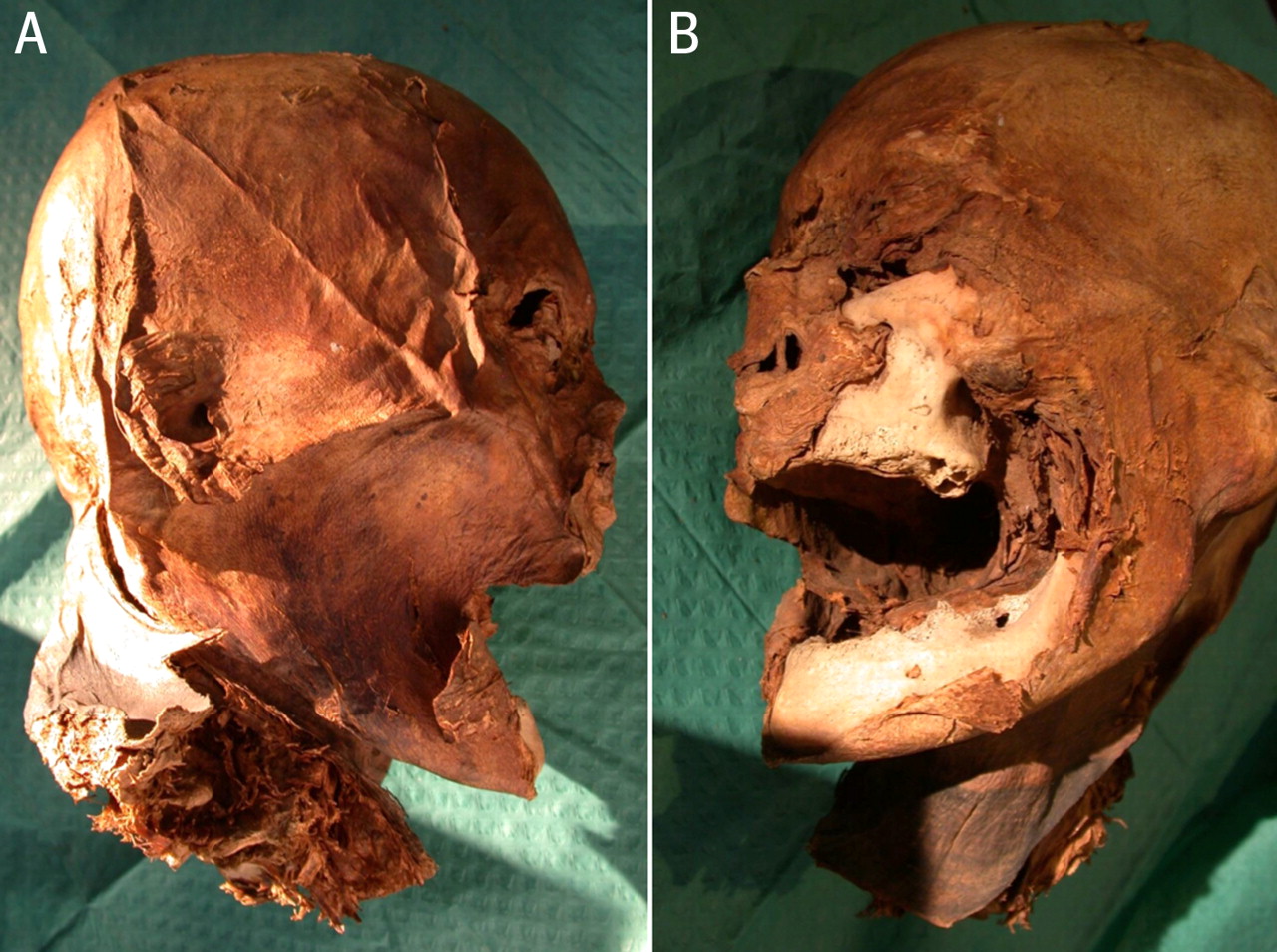
Some days ago I read an article in a site talking about the embalmed head of Henry IV (originally Henri IV).
When I finished to read the article I rapidly started to search about matter to make a forensic approximation. However, how mostly of times, I find few things to work.
The mostly of images found was of the embalmed head. It is difficult to put the tissue depth marks because you can make some mistake and compromising the result of the approximation.
Resignedly I researched more on the internet until find a link, where an user called Patrick (thank you!) wrote about an article with a lot of image and two videos, one of a endoscopy ans other about CT-Scan.
When I saw the video of CT-Scan rotating, I imagined that would be able to reconstruct it using one of the automated technology that I had:
1) By SfM (opensource)
2) With Stereoscan (freeware)
3) With 123D Catch (freeware, running on Linux by Wine)
4) With Blender tracking (opensource)
5) With Voodoo Tracker (freeware)
But before, I needed to download the video. I thought that the Videodownloader Helper would be able to be this, but I was wrong.
When I tryed to open the video on Google Chrome, I received the link and the Vlc/Totem players opened the animation.
So I made a experience without pretentions writing a command line, where FFMPEG converts the online streming video in a image sequence on my pc:
FFMPEG surprised me, but none of that cited technology of automatic reconstruction worked. Some because of the characteristics others, maybe, because of my incompetence.
In fact, I had to import the sequence inside Blender and tracking the 3D object manually, using the sequence how reference.
If you see the frame where the skin starts to appear you'll see that the skull was not modeled, instead this you'll see some reference lines. The tissue depth markers was put using these lines and the image how reference.
The skulls that appear are only background images.
The next step is refine the technique always thinking on evolution of knowledge.
But, more important than this is to share what I learned with you, dear reader.
I hope you enjoy. A big hug and I see you in the next!